

Sustainability · 2025
In this section52 topics
- Sustainability Policy2 items
- Sustainability Goals & UN SDGs3 items
- Policy Review3 items
- Business Value Chain1 item
- Stakeholder Analysis1 item
- Environmental Policy & Guidelines3 items
- Environmental Policy Review3 items
- Energy — Plan & Guidelines2 items
- Energy — Electricity Consumption1 item
- Energy — Fuel Consumption1 item
- Energy — Targets3 items
- Energy — Performance & Outcomes2 items
- Water — Plan & Guidelines2 items
- Water — Withdrawal, Discharge & Consumption1 item
- Water — Targets3 items
- Water — Performance & Outcomes2 items
- Waste — Plan & Guidelines2 items
- Waste — Generation, Disposal & Recycling1 item
- Waste — Targets3 items
- Waste — Performance & Outcomes2 items
- GHG — Plan & Guidelines2 items
- GHG — Emissions1 item
- GHG — Emissions Verification2 items
- GHG — Principles & Standards1 item
- GHG — Targets1 item
- GHG Targets — Net Zero1 item
- GHG Targets — Carbon Neutrality1 item
- GHG — Performance & Outcomes2 items
- Environmental Legal Incidents2 items
- Other Environmental Management1 item
- Social Policy & Guidelines5 items
- Social Policy Review3 items
- Social — Principles & Standards Practised1 item
- Human Rights Due Diligence2 items
- Employees — Plan & Guidelines3 items
- Employees — Workforce1 item
- Employees — Remuneration & Provident Fund1 item
- Employees — Training & Development1 item
- Employees — Occupational Health & Safety1 item
- Employees — Labour Relations1 item
- Employees — Employee Representation2 items
- Employees — Targets2 items
- Employees — Performance & Outcomes2 items
- Customers — Plan & Guidelines3 items
- Customers — Satisfaction Results1 item
- Customers — Targets2 items
- Customers — Performance & Outcomes2 items
- Community & Social — Plan & Guidelines3 items
- Community & Social — Targets2 items
- Community & Social — Performance & Outcomes2 items
- Other Social Management1 item
- Law Violation Incidents1 item
Sustainability Policy
Has a Sustainability Policy
Yes
Policy Description
Principal Capital Public Company Limited (“PRINC” or “we”) operates in the medical services, healthcare, and private hospital sectors. The company is committed to sustainable growth with social and environmental responsibility, ensuring continuous benefits for all stakeholders including shareholders, investors, partners, employees, society, and the environment.
Driven by our organizational mission and commitment to building a strong community foundation through good health, which aligns with the United Nations’ Sustainable Development Goals (SDGs), specifically Goal 3: Ensure healthy lives and promote well-being for all at all ages, PRINC adheres to the principles of sustainable development in its business operations. This involves collaboration and understanding with all stakeholders. The Board of Directors and the Executive Committee have approved the business direction based on the following three-pronged sustainable development policy (Harmony of Heart, Harmony of Stewardship, Harmony of Governance):
Harmony of Heart
Increasing the accessibility of quality healthcare services at reasonable prices to secondary cities or areas where public health services are insufficient for the needs of the locals (aligning with UN SDG 3: Good Health and Well-Being).
Emphasizing the prevention of human rights violations, adhering to equality, treating employees equally, ensuring fairness in compensation, benefits, safety, and health at work, opportunities for career advancement, promoting training to enhance knowledge and skills, fostering engagement between employees and the organization, and supporting the education of employees' children, youth, and the underprivileged in society (in line with UN SDG 4 : Quality Education, SDG 5: Gender Equality, and SDG 8: Decent Work and Economic Growth).
Under the Harmony Project, creating works for the community, and bringing people back to their hometowns to play a part in stimulating the local economy through promoting local employment, using local entrepreneurs, and integrating geographical identity into various aspects of the business. Encouraging employees to participate in creating benefits for the development of quality of life and the economy for both the internal and external society, directly and indirectly, through business processes and organizational activities (corresponding with
UN SDG 8 : Decent Work and Economic Growth and SDG 11: Sustainable Cities and Communities).
Harmony of Stewardship
Emphasize environmental management by considering potential impacts, ensuring safety, efficient resource utilization, and energy conservation (aligned with UN SDG 6: Clean Water and Sanitation, SDG 7: Affordable and Clean Energy, SDG 12: Responsible Consumption and Production, and SDG 13: Climate Action).
Creating value and quality by focusing on the development of services and products that reduce negative impacts on consumers and the environment, aiming to enhance quality of life and better meet consumer needs. (aligned with UN SDG 12: Responsible Consumption and Production, and SDG 13: Climate Action).
Harmony of Governance
Promote business growth with transparency, implement good corporate governance policies, and maintain organizational ethics that consider stakeholder, social, and environmental benefits. Manage stakeholder relationships fairly, promote free trade, avoid conflicts of interest, and combat all forms of corruption (aligned with UN SDG 16: Peace, Justice, and Strong Institutions).
Support and encourage stakeholder creativity and continuously consider partnerships to co-develop innovations that add value to the community, society, and the environment, alongside sustainable business growth (aligned with UN SDG 17: Partnerships for the Goals).
Sustainability Goals & UN SDGs
Has Sustainability Goals
Yes
Goals Description
Identification and Assessment of Material Sustainability Topics
Over the past year, the economic slowdown, uncertainty arising from unrest in border areas, and adjustments within the health insurance sector have influenced public behavior and patterns of healthcare service utilization. In this context, the Company has reviewed the business environment and stakeholder expectations to identify and prioritize sustainability issues that are material to the Company’s operations and long-term growth.
This process also supports the Company’s strategic planning to drive the business in alignment with sustainability principles. Accordingly, emerging trends have been incorporated as key considerations in assessing potential risks and opportunities across multiple dimensions. The process for identifying and determining material issues is outlined in the following steps:
Identification of Key Trends and Sustainability Topics
The Company conducted a comprehensive review covering:
Global megatrends and emerging developments
Sustainability issues prioritized at the international level
Changes in laws, regulations, and regulatory requirements
Stakeholder engagement and feedback collection
Classification of Material Topics under the ESG Framework
Material topics were categorized through consideration of:
Results from previous materiality assessments
Sustainability priorities identified by responsible internal functions
Business-specific material issues relevant to the healthcare sector
Assessment of Outward Impacts (Inside-Out Perspective)
External impacts generated by the Company’s operations were evaluated based on:
Severity of impact
Scope of impact
Irremediability of impact
Likelihood of occurrence
Mitigation capability
Assessment of Inward Impacts (Outside-In Perspective)
Potential impacts on the organization were assessed across:
Financial implications
Business growth impacts
Legal and regulatory exposure
Corporate image and reputational risks
Senior executives from multiple functional areas jointly reviewed the assessment results before submission to the Top Executive.
Material sustainability topics were subsequently approved by the Executive Committee and the Sustainable Development Committee.
Categorization of Material Topics
The Company classified material sustainability topics into three ESG dimensions:
Environmental (4 Topics) | Social (4 Topics) | Governance and Economic (8 Topics) |
|
|
|
Impact Assessment of Material Sustainability Topics
The Company continues to apply a double materiality approach, evaluating sustainability topics from both:
the impact created by the organization (inside-out), and
the impact affecting the organization (outside-in).
Criteria for External Impact Assessment
Severity
Scope
Irremediability
Likelihood
Mitigation effectiveness
Material topics were analyzed in terms of risks and opportunities across economic, social, and environmental dimensions.
Materiality Topic | Risk | Opportunity | ||||
Economic | Social | Environment | Economic | Social | Environment | |
Water Stewardship | / | / | / | / | / | / |
Waste Management | / | / | / | / | / | / |
Energy Management | / | / | / | / | ||
Climate Change | / | / | / | / | / | / |
Human Rights, Diversity, Equity and Inclusion | / | / | / | |||
Talent Development, Attraction, and Retention | / | / | / | / | ||
Employee Well-being, Occupational Health, and Safety | / | / | / | |||
Access to Healthcare Services and Community Well-being | / | / | / | / | ||
Personal Data Breaches and Data Security | / | / | ||||
Service Quality, Safety, and Customer Satisfaction | / | / | / | / | ||
Business Integrity | / | |||||
Risk and Crisis Management | / | / | ||||
Supply Chain Management | / | / | / | / | ||
Innovation and Technology | / | / | / | |||
Digitalization and Digital Transformation | / | / | / | |||
Strategic Partnership and Collaboration for Sustainable Development | / | / | / | |||
Organizational Impact Evaluation Criteria
Internal impacts were assessed across three key dimensions:
Financial and business growth impact
Reputation and stakeholder trust
Regulatory impact
Assessment criteria are aligned with the Company’s enterprise risk management framework.
Score | Business Growth / Financial | Reputation/Trust | Regulatory | |
Risk | Opportunities | |||
0 = No Impact | No financial impact or loss of future revenue. | No financial impact or future revenue generation. | No impact on the company’s reputation or credibility. | No legal or regulatory impact. |
1 = Low | Minor financial impact, such as increased costs, increased expenses, or revenue loss not exceeding THB 1 million. | Minor financial impact, such as additional revenue generation not exceeding THB 1 million. |
| Verbal warning received but not in violation of the law. |
2 = Moderate | Moderate financial impact, such as increased costs, increased expenses, or loss of revenue or sales opportunities exceeding THB 1 million but not exceeding THB 10 million. | Moderate financial impact, such as increased revenue generation or business opportunities valued at more than THB 1 million but not exceeding THB 10 million. |
|
|
3 = High | Significant financial impact, including increased costs, increased expenses, or loss of revenue or sales opportunities exceeding THB 10 million. | High financial impact, including increased revenue generation or business opportunities valued at more than THB 10 million. |
|
|
Prioritization of Material Topics
After identifying material sustainability topics, the Company conducted a prioritization process and obtained the results identifying seven sustainability topics with the highest impact on both stakeholders and the organization, as follows:
Water Stewardship
Waste Management
Employee Well-being, Occupational Health, and Safety
Personal Data Breaches and Data Security
Service Quality, Safety, and Customer Satisfaction
Business Integrity
Risk and Crisis Management
Materiality Assessment Matrix
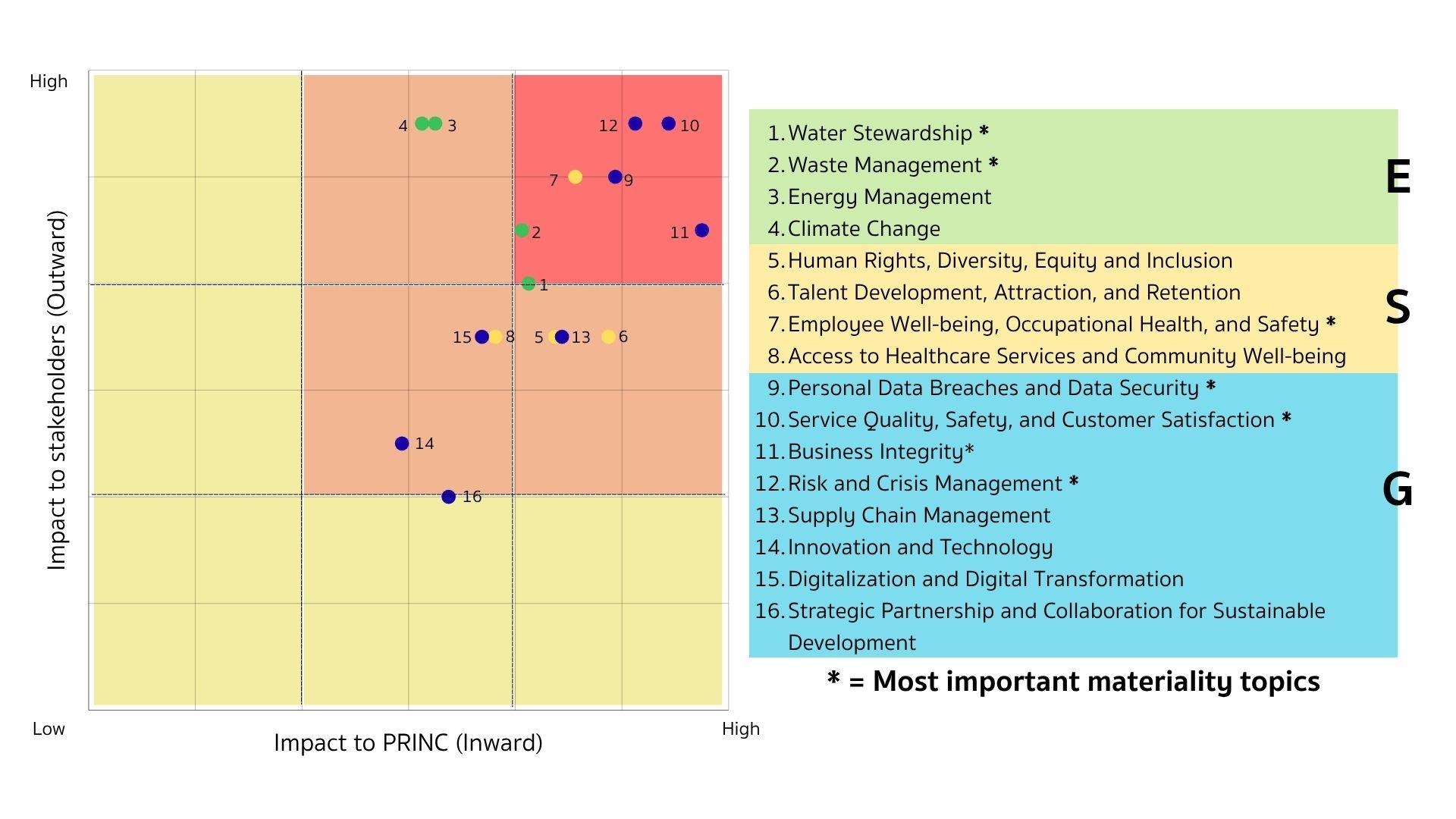
Verification and Disclosure of Material Topics
All material sustainability topics were reviewed by senior executives across diverse functional areas to ensure comprehensive coverage across all dimensions. The review included executives from Human Resources, Engineering and Construction, Administration, Sustainability, Marketing, and Medical functions.
The material topics were subsequently reviewed by the Top Executive prior to submission to the Executive Committee and the Sustainability Development Committee.
The Company’s material sustainability topics are disclosed in the Annual Report (Form 56-1 One Report).
Corporate Sustainability Targets
Short-Term Targets
Expand hospital operations into secondary cities to address community healthcare needs, strengthen family institutions by enabling employees to return to their hometowns, and uplift local economies through local employment, with a target of 20 hospitals.
Enhance medical service standards through accreditation by the Healthcare Accreditation Institute (HA) and Joint Commission International (JCI), targeting HA certification for all hospitals and international accreditation for hub hospitals.
All hospitals within the network must obtain Green & Clean Hospital certification from the Department of Health.
Strengthen transparency and employee care practices by achieving recognition as an Outstanding Establishment in Labour Relations and Welfare, and as a Model Establishment in Safety, Occupational Health, and Working Environment, with the target of receiving such awards or certifications across all hospitals.
Develop internal personnel capabilities alongside external recruitment, with the objective of establishing successors across 20 hospitals to support business expansion.
Promote educational support for children of low-income employees, targeting 100% coverage for eligible employees’ children.
Create employment opportunities for persons with disabilities through direct hospital employment and through collaboration with the Social Innovation Foundation or under Section 35 of the Social Security Act, with direct employment expanding in line with business growth.
Achieve zero complaints regarding sensitive issues, including unfair treatment or inequality related to religion, nationality, gender identity, or other factors.
Achieve zero lost-time injuries (LTIFR – Loss Time Injury Frequency Rate = 0).
Collaborate in developing community-based products from local areas where hospitals operate and integrate them into hospital operations, with continuous annual development targets.
Ensure 100% of critical direct suppliers (critical tier 1) and critical indirect suppliers (critical non-tier 1) undergo sustainability performance assessments.
Manage waste effectively with a general waste to recyclable waste ratio of 50:50, and infectious waste generation not exceeding 0.4 per bed.
Increase the use of environmentally friendly materials in hospital construction and renovation processes.
Reduce greenhouse gas emissions per service unit by 5% compared to the previous year.
Reduce electricity consumption per service unit by 10% compared to the previous year.
Increase the proportion of clean energy consumption across the network to 20% by 2028.
Reduce water consumption per service unit by 10% compared to the previous year.
Implement water reduction initiatives, targeting all hospitals to reuse treated wastewater within operations.
Long-Term Target
Implement operations that reduce greenhouse gas emissions, with the target of achieving Net Zero Greenhouse Gas Emissions by 2049.
UN Sustainable Development Goals
| SDG Goal |
|---|
| Goal 1 No Poverty |
| Goal 1 No Poverty |
| Goal 3 Good Health and Well-being |
| Goal 3 Good Health and Well-being |
| Goal 4 Quality Education |
| Goal 4 Quality Education |
| Goal 5 Gender Equality |
| Goal 6 Clean Water and Sanitation |
| Goal 6 Clean Water and Sanitation |
| Goal 7 Affordable and Clean Energy |
| Goal 7 Affordable and Clean Energy |
| Goal 8 Decent Work and Economic Growth |
| Goal 8 Decent Work and Economic Growth |
| Goal 10 Reduce Inequalities |
| Goal 10 Reduce Inequalities |
| Goal 11 Sustainable Cities and Communities |
| Goal 11 Sustainable Cities and Communities |
| Goal 12 Responsible Consumption and Production |
| Goal 12 Responsible Consumption and Production |
| Goal 13 Climate Action |
| Goal 13 Climate Action |
| Goal 16 Peace, Justice and Strong Institutions |
| Goal 16 Peace, Justice and Strong Institutions |
| Goal 17 Partnerships for the Goals |
| Goal 17 Partnerships for the Goals |
Policy Review
Policy Reviewed This Year
Yes
Policy Changed This Year
Yes
Review Details
Over the past year, the Company has reviewed and refined its sustainability targets to align with the evolving business landscape and stakeholder expectations. As part of this process, an additional target has been introduced to ensure that Human Rights Due Diligence is conducted across all hospitals within the network, strengthening the Company’s systematic management of human rights risks in line with international practices.
At the same time, the Company has achieved a key milestone in relation to its existing commitments. In 2025, the Company successfully met its target of obtaining the Green and Clean Hospital certification, with all hospitals within the network receiving the certification as planned. This achievement reflects the Company’s ongoing commitment to enhancing environmental management and hygiene standards across its healthcare facilities.
Business Value Chain
Value Chain Description
The company’s sustainability drive begins with an assessment of the business value chain. The value chain is illustrated in the diagram, showing how each process from upstream to downstream is conducted with care and attention.
Primary Activities
Caring Solution & Operation
Stakeholders : Customers, Employees, Outsourced Staff, Specialist, Suppliers, Business Partners, Government Authority.Analyze health issues and needs of the local population.
Design health-related products suitable for the local population.
Develop processes to reduce negative impacts in a comprehensive and sustainable manner.
Collaborate to create broad positive impacts.
Recruit personnel and specialists with the competence and values aligned with the organization.
Build systems that are fast, safe, and meet standards.
Manage medical equipment and adopt technologies to enhance service efficiency.
Utilize resources efficiently and pay attention to every process to reduce environmental impacts.
Use technology to enhance healthcare efficiency and expand access to healthcare in secondary cities.
Leverage the network to share resources and knowledge.
Application of Artificial Intelligence (AI) to support medical diagnosis, clinical decision-making, and healthcare data management in collaboration with physicians and nurses, with the aim of enhancing treatment efficiency, improving service accuracy, and strengthening the overall patient experience in the long term.
Caring Marketing
Stakeholders : Employees, Customers, Industry Peers.Utilize marketing strategies driven by technology and data.
Increase customer engagement in service improvement.
Practice sustainable marketing with transparency to foster fair competition.
Caring Service
Stakeholders : Customers, Employees, Specialists, Suppliers, Business Partners.Continuously improve service quality through innovation and technology.
Provide effective treatment and care.
Promote a culture of service excellence with a focus on patient-centric approach.
Promote sustainable social well-being.
Caring Ecosystems
Stakeholders : Customers, Communities, Employees, Specialists, Suppliers, Business Partners, Shareholders, Creditors, Government Authority.Build good relationships with stakeholders involved in business operations.
Promote stakeholder participation within service areas.
Establish business partnerships with government and private sectors that prioritize sustainable development.
Foster business growth in all dimensions alongside stakeholder development.
Source and procure from local communities, suppliers, partners, and organizations that value sustainable practices (Sustainable Supply Chain).
Support Activities
Procurement
A transparent and fair procurement process.
Setting goals toward a sustainable supply chain.
Technology Development
Recruitment and investment in technologies and innovations that enhance treatment efficiency, as well as technologies that reduce negative impacts and increase positive impacts on the environment, communities, and society in a sustainable manner.
Take into consideration information security as well as the safeguarding of personal data.
Application of Artificial Intelligence (AI) to support medical data analytics, disease diagnosis, and the enhancement of organizational operational efficiency.
Human Resource Management
Employee care and potential development to support business expansion and create career advancement paths for staff.
Emphasizing local employment.
Infrastructure
Comply with strong corporate governance standards with transparency and strict oversight measures.
Anti-corruption and whistleblowing mechanisms.
Stakeholder Analysis
Stakeholder Analysis
| Stakeholder Type | Stakeholders | Stakeholder Expectations | Response to Expectations | Communication Activities |
|---|---|---|---|---|
| Internal stakeholders | 2921 · Description: Employees | 1. Fair compensation and benefits.
2. Career growth and job security.
3. Continuous development of capabilities and skills.
4. Fairness, equity, and equality.
5. Adequate facilities and equipment to support job performance.
6. Support with appropriate staffing levels.
7. Positive working environment.
8. Promotion of self-worth and self-value.
9. Physical work environment and safety.
10. Work–life balance. | 1. Annual salary adjustments benchmarked against industry standards, along with annual bonus payments.
2. Special incentive compensation provided to boost morale in hospitals experiencing increased workloads.
3. Provision of a knowledge-based loan welfare program in collaboration with Noburo Platform Co., Ltd. to support employees with credit bureau records.
4. Enhancement of employees’ financial literacy through investment and financial management programs delivered by partner organizations.
5. Adjustment of wages in compliance with the national minimum wage regulation effective 1 July 2025.
6. Implementation of capability enhancement programs for supervisors and managers to support career progression, including internal talent selection to participate in the PRINC Next-Dot Season 2 program, an intensive and comprehensive development initiative preparing high-potential employees for advancement to Executive Director positions and Hospital Executive Director.
7. Further development of the Individual Development Plan (IDP) framework in 2025, incorporating a more systematic performance and development outcome tracking mechanism.
8. Establishment of an annual training plan and expansion of learning modules via the e-learning platform to leverage technology in enhancing employee learning effectiveness.
9. Communication of corporate performance and strategic direction to employees through hospital-level town halls (conducted at least once annually at every hospital), alongside quarterly networking initiatives to strengthen cross-functional collaboration.
10. Annual disclosure of clear criteria for salary increment evaluations and bonus allocations to ensure transparency and consistency.
11. Provision of complimentary influenza vaccinations for employees, with vaccines offered to employees’ family members at cost price.
12. Procurement of standardized protective equipment and annual workplace inspections to ensure alignment with occupational health and safety standards, with continuous improvement measures implemented as required.
13. Workforce management across the network based on seasoning principles to optimize staffing allocation, alleviate employee workload, and sustain hospital service efficiency.
14. Organized or participated in initiatives that promote intellectual well-being and mental health, such as hosting workshops (e.g., scented candle workshops), implementing the “Mind Friend Clinic” initiative, and participating in the WellnessCNB program. | 2940 · Description: Social Event · 2941 · Description: Online Communication · 2942 · Description: Internal Meeting · 2945 · Description: Complaint Reception · 2946 · Description: Employee Engagement Survey · 2947 · Description: Satisfaction Survey · 2949 · Other name: Employee development and training needs assessment · Description: Others · 2949 · Other name: Conducting Focus Groups and Organization Development Workshops · Description: Others · 2949 · Other name: Annual Performance Evaluation and 360-Degree Assessment · Description: Others · 2949 · Other name: Meeting with Senior Executives through the Annual Success Partner Meeting (Townhall) · Description: Others · 2949 · Other name: The Welfare Committee in each hospital · Description: Others |
| Internal stakeholders | 2907 · Description: Specialists | 1. Treatment standards across hospitals in the network.
2. Continuous development of medical treatment capabilities.
3. Upgrading treatment with modern medical
equipment.
4. Applying appropriate technology to enhance service quality. | 1. Ongoing accreditation and recertification of hospital quality standards by both domestic and international accrediting bodies, ensuring continuous compliance and sustained excellence in healthcare delivery.
2. Enhancement of medical secretary competencies through alignment with the Quality Center and the establishment of network-wide standards, strengthening physician support functions across the organization.
3. Regular organization of seminars and knowledge-sharing sessions for physicians and nurses, along with engagement activities to foster stronger professional relationships. In 2026, the initiative will be further expanded to integrate collaboration across the entire network.
4. Development of a physician network to elevate clinical excellence and reinforce treatment capabilities at the network level. | 2938 · Description: Visit · 2942 · Description: Internal Meeting · 2943 · Description: External Meeting · 2945 · Description: Complaint Reception · 2946 · Description: Employee Engagement Survey · 2948 · Description: Training / Seminar · 2949 · Other name: Networking and Social Gathering Activities · Description: Others |
| External stakeholders | 2923 · Description: Customers | 1. Reasonable medical treatment costs.
2. Quality healthcare services.
3. Diverse services that meet needs.
4. High standards of service.
5. Promotion of health literacy and preventive health awareness. | 1. Provision of healthcare services at price points lower than those in Bangkok, benchmarked against local cost-of-living indices, alongside participation in government reimbursement schemes to enhance accessibility for the broader population.
2. Implementation of a robust quality management system with regular internal audits to ensure compliance with clinical standards, including applications for accreditation from both domestic and international external bodies.
3. Deployment of digital technologies to expand access to quality healthcare services across all provinces within the network, including the integration and transferability of medical records to enable continuity of care throughout the network.
4. Conducting localized needs assessments and data analytics to identify community health trends, with the development of service offerings aligned to prevalent disease patterns and regional demand.
5. Delivery of service excellence training programs and systematic monitoring of service-related complaints to ensure continuous improvement in patient experience.
6. Expansion of on-site amenities within hospital premises to enhance convenience, such as lifestyle-oriented retail outlets and EV charging stations.
7. Strengthening specialized and complex medical service lines to broaden the scope of care and elevate comprehensive healthcare coverage.
8. Restructuring of the hospital website architecture to enhance user accessibility, improve navigation efficiency, and deliver a more seamless digital experience.
9. Development of targeted content strategies, leveraging AI-enabled tools to better align communications with evolving consumer behaviors and needs—such as disease prevention guidance and health promotion education.
10. Strategic equity investment in P.Phathya Hospital 1 and P.Phathya Hospital 2 in Nakhon Ratchasima Province, positioning the network to strengthen its footprint and elevate its role as a leading healthcare hub in the Northeastern region of Thailand. | 2938 · Description: Visit · 2939 · Description: Press Release · 2940 · Description: Social Event · 2941 · Description: Online Communication · 2945 · Description: Complaint Reception · 2947 · Description: Satisfaction Survey · 2948 · Description: Training / Seminar · 2949 · Other name: PRINC Health Application · Description: Others · 2949 · Other name: Participation in public exhibitions, large-scale events, and government-organized programs. · Description: Others |
| External stakeholders | 2902 · Description: Community | 1. Medical treatment at affordable prices.
2. Better, more accessible, and standardized services than public healthcare.
3. Local employment.
4. Uplifting community development.
5. Availability of specialized doctors and medical equipment.
6. No negative social or environmental impact on the community.
7. Participation in local traditions and cultural
promotion activities. | 1. Providing public health services at lower prices than in Bangkok, based on local cost of living.
2. Conducting satisfaction evaluations and service behavior training.
3. Employment policy prioritizes hiring local residents.
4. Supporting local service providers and businesses, and incorporating local identity into operations.
5. Collaborating to develop or enhance local products in communities where hospitals are located, to increase recognition.
6. Procuring doctors and equipment suitable for local health needs.
7. Complying with regulations on wastewater treatment and waste disposal to avoid negative community impact. | 2938 · Description: Visit · 2940 · Description: Social Event · 2941 · Description: Online Communication · 2945 · Description: Complaint Reception · 2948 · Description: Training / Seminar |
| External stakeholders | 2899 · Description: Suppliers | 1. Transparency in the selection process.
2. Timely payment for goods and services.
3. Long-term relationships. | 1. Clarify bidding procedures and issue TORs for all procurements, and provide evaluation results to discuss development approaches.
2. Implement e-bidding to enhance transparency in the process.
3. Communicate anti-corruption policies and provide channels for reporting misconduct during collaboration.
4. Set clear payment schedules and ensure timely payment for goods and services.
5. Conduct annual evaluations and communicate unmet expectations to support improvement and development.
6. Collaborate on pricing direction, including
addressing raw material shortages and finding joint solutions.
7. Provide training to vendors on essential topics.
8. Gather feedback on needs for support in sustainable operations. | 2941 · Description: Online Communication · 2943 · Description: External Meeting · 2949 · Other name: Annual Evaluation and Selection of Suppliers · Description: Others · 2949 · Other name: Self-Assessment of Suppliers · Description: Others |
| External stakeholders | 2928 · Description: Society | 1. Responsibility towards people in society and creating positive impacts on various social aspects.
2. Responsibility towards the environment and
reducing negative environmental impacts. | 1. Developing service potential and consistently applying for various standards to build confidence.
2. Supporting equality / hiring people with disabilities / committed to respecting human rights principles.
3. Monitoring and inspecting wastewater treatment before release into communities, and expanding the “Care the Whale” project to hospitals in the network to improve waste management; beginning to build partnerships with allies and communities.
4. Implementation of community and social development initiatives under the investment promotion measures approved in 2024 by the The Board of Investment of Thailand (BOI) across three provinces, with project execution spanning 2025–2026. | 2940 · Description: Social Event · 2941 · Description: Online Communication · 2949 · Other name: Public relations signage, Newsletter publications, Community radio broadcasts, Mobile public announcement vehicles. · Description: Others |
| External stakeholders | 2900 · Description: Business partners | 1. Reasonable return on investment within an
appropriate timeframe.
2. Transparency in business operations.
3. Opportunities to expand and grow the business together. | 1. Compliance with applicable laws and regulations, adherence to good corporate governance principles, and commitment to business ethics and codes of conduct.
2. Regular communication and transparent reporting of operational performance and key developments.
3. Strengthening mutual business understanding through initiatives such as site visits to operational areas in each province, providing partners with visibility into management approaches and operational standards.
4. Joint development of business opportunities to create shared value and long-term growth.
5. Promotion of sustainability collaboration, including the advancement of ESG best practices in partnership with key stakeholders.
6. Capacity building and knowledge exchange through networking and knowledge-sharing platforms, fostering the exchange of experience, strategic perspectives, and management approaches. | 2943 · Description: External Meeting · 2948 · Description: Training / Seminar |
| External stakeholders | 2894 · Description: Creditor | 1. Timely debt repayment and contract compliance.
2. Long-term partnership. | 1. Clear operational plans and consistent execution to meet contractual goals.
2. Discussion of long-term investment and business expansion plans.
3. Increased staffing in financial planning, investor relations, and negotiation to support business growth. | 2943 · Description: External Meeting |
| External stakeholders | 2913 · Description: Shareholders | 1. Consistent growth in dividends and stock price.
2. Ongoing business expansion.
3. Good corporate governance. | 1. Organizational and executive team restructuring to ensure alignment with strategic direction, alongside the reinforcement of the leadership bench to drive performance more closely and deliver operating results that better meet shareholder expectations.
2. Ongoing review and enhancement of corporate policies to ensure full alignment with good corporate governance principles.
3. Strict adherence to governance policies, with accurate and transparent disclosure of information.
4. Continuous pursuit of business expansion opportunities to strengthen revenue generation across the Group.
5. Advancement of operational excellence initiatives to optimize cost control and elevate efficiency, leveraging technology and AI as key enablers through the development of a Productivity & Efficiency Dashboard on the Tableau BI analytics platform. | 2938 · Description: Visit · 2939 · Description: Press Release · 2941 · Description: Online Communication · 2943 · Description: External Meeting · 2944 · Description: Annual General Meeting (AGM) |
| External stakeholders | 2931 · Description: Government agencies and Regulators | 1. Full compliance with laws and regulations.
2. Collaboration in various activities. | 1. Maintaining operational standards and continuously updating knowledge of new regulations.
2. Conducting comprehensive due diligence prior to investment, including verification of the target entity’s compliance with applicable laws, regulations, and regulatory requirements.
3. Cooperation in supporting various activities, such as National Labor Day events. | 2943 · Description: External Meeting · 2949 · Other name: Preparation of Reports in Compliance with Regulations · Description: Others · 2949 · Other name: Participation in Government Activities · Description: Others |
Environmental Policy & Guidelines
Has an Environmental Policy
Yes
Policy Description
Over the past year, climate change trends have continued to be concerning. Global efforts to limit the rise in average global temperature to within 1.5 Degree Celsius above pre-industrial levels—a target set in the 2015 Paris Agreement—have not been successful.
As a stakeholder of this planet, the Company prioritizes advancing its "Harmonized Stewardship" strategy through an environmental policy that encourages each hospital to implement the following measures:
Comply with all applicable environmental laws, regulations, and standards, such as the Notification of the Ministry of Natural Resources and Environment on types of buildings considered pollution sources that must control wastewater discharge, and the Ministerial Regulation on Infectious Waste Disposal B.E. 2545. Regular monitoring and oversight of key performance indicators is also conducted.
Emphasize efficient use of resources, including electricity and water, and promote the 3Rs (Reduce, Reuse, Recycle) principles.
Increase the proportion of clean energy sources used.
Source materials and services throughout the value chain with consideration for environmental impacts.
Develop services and products that reduce impact on both consumers and the environment.
Promote environmental awareness and encourage employees to act responsibly toward environmental impacts.
Seek partnerships to jointly reduce environmental impacts.
Apply for relevant environmental certifications such as the Green & Clean Hospital standard.
Assess the risks associated with the impacts of climate change and develop preparedness measures to address such risks.
Environmental Guidelines
| Guideline |
|---|
| Electricity Management |
| Renewable/Clean Energy Management |
| Water Management |
| Waste Management |
| Greenhouse Gas and Climate Change Management |
Environmental Policy Review
Policy Reviewed This Year
Yes
Review Details
Previously, the Company established a target to reduce greenhouse gas (GHG) emissions per patient served by 5% from the base year. To align with international standards, the Company has formally declared its commitment to the Science Based Targets initiative (SBTi) to set science-based net GHG reduction targets.
Under SBTi criteria, organizations are required to reduce absolute GHG emissions by more than 90% by the target year prior to applying carbon offset mechanisms, with offsets permitted for no more than 10% of total residual emissions.
The Company is committed to implementing this pathway in a concrete and measurable manner, supporting the global objective of limiting temperature rise to no more than 1.5 Degree Celsius in alignment with the Paris Agreement
Policies & Guidelines Changed
| Change |
|---|
| Greenhouse Gas and Climate Change Management |
Energy — Plan & Guidelines
Has an Energy Management Plan
Yes
Plan Description
Electricity is a major source of greenhouse gas emissions for hospitals, as they operate 24 hours a day and require cold storage to maintain the temperature of medications and medical supplies. Each hospital therefore implements three main strategies tailored to its specific context—such as building age, air conditioning systems, and patient volume.
Three main strategies:
Use of Electricity from Clean Energy Sources
Improving System Efficiency
Energy — Electricity Consumption
Electricity Consumption
| Metric | Current Year | Previous Year | Two Years Ago |
|---|---|---|---|
| Total electricity consumption within the organization (Kilowatt-Hours) | 31,070,316.14 | 31,380,498.68 | 30,656,518.47 |
| Electricity purchased for consumption from non-renewable energy sources (Kilowatt-Hours) | 29,037,866.14 | 29,437,518.68 | 30,123,131.19 |
| Electricity purchased or generated for consumption from renewable energy sources (Kilowatt-Hours) | 2,032,450 | 1,942,980 | 533,387.28 |
Energy — Fuel Consumption
Fuel Consumption
| Metric | Current Year | Previous Year | Two Years Ago |
|---|---|---|---|
| Crude oil (Barrels) | |||
| Coal (Metric tonnes) | |||
| Jet fuel (Litres) | |||
| Diesel (Litres) | 253,868.86 | 177,242.68 | 260,553.36 |
| Gasoline (Litres) | 92,962.38 | 108,008.93 | 92,402.01 |
| Fuel oil (Litres) | |||
| Natural gas (Standard cubic feet) | |||
| LPG (Kilograms) | 12,547.8 | 30,951 | 45,090 |
| Steam (Metric tonnes) |
Energy — Targets
Introduction
Since hospital electricity consumption is directly related to the number of patient visits each year, the company has established an energy management indicator based on electricity usage per patient per year (measured in kilowatt-hours/person/year). This metric is used to set targets and track progress, ensuring efficient energy management that aligns with service demand.
Has Set Targets
Yes
Targets
| Target | Base Year | Base Year Value | Target Year | Target Year Value | Target Change (%) | Unit | Unit — Please Specify | Per Unit (Intensity) | Per Unit — Please Specify |
|---|---|---|---|---|---|---|---|---|---|
| Reduction of electricity purchased and fuel consumption | 2,024 | 72.74 | 2,025 | 7.27 | 10 | Kilowatt-hour | Other | Number of Users per Year | |
| Increase of electricity consumption from renewable energy sources | 2,025 | 8.23 | 2,028 | 11.77 | Others | percent |
Energy — Performance & Outcomes
Has Performance Results
Yes
Performance Description
In line with the Company’s target to reduce energy consumption intensity by 10% from the 2024 baseline by 2025, the Company was unable to achieve the stated target. Performance results indicated that energy consumption intensity increased by 4.07% compared with the baseline year.
In 2024, the Company recorded electricity consumption of 72.74 kWh per person per year, which increased to 75.70 kWh per person per year in 2025.
Renewable Energy Utilization
The Company, in collaboration with its shareholders and key partners, including RATCH Group Public Company Limited through its subsidiary, Ratch Development Energy Public Company Limited, initiated solar photovoltaic (Solar Cell) installations across hospitals within the network starting in 2022.
In 2025, solar installations were completed at one additional hospital, increasing from seven sites completed in 2024 to a total of eight hospitals, comprising:
Princ Hospital Lamphun
Princ Hospital Sakon Nakhon
Princ Hospital Sisaket
Princ Hospital Uthai Thani
Princ Hospital Ubon Ratchathani
Pitsanuvej Uttaradit Hospital
Princ Hospital Paknampo 1
Princ Hospital Mukdahan
As a result of these solar energy installations, the Company generated a total of 1,922 MWh of renewable electricity in 2025, representing 18.87% of total electricity consumption across the eight hospitals.
Across the entire hospital network, renewable energy accounted for 8.23% of total electricity consumption, with a target to increase the share of clean energy to 20%.
The Company remains committed to increasing the share of renewable energy while continuously implementing energy efficiency improvement measures. Preparations are underway for additional solar installations in 2026 at the following hospitals:
Virajsilp Hospital Chumphon
Thanakan Hospital
P.Phathya Hospital 1 and P.Phathya Hospital 2
Energy Efficiency Improvements
In 2025, the Company implemented multiple initiatives to enhance energy and resource efficiency across its hospital network, as detailed below.
Pitsanuvej Phitsanulok Hospital installed an Automatic Voltage Regulator (AVR) system in 2025, achieving energy savings of 560,358 kWh, equivalent to a 9.32% reduction. Total electricity consumption was 5,864,871.20 kWh in 2024 and decreased to 5,448,937.00 kWh in 2025, representing a reduction of 415,934.20 kWh and electricity cost savings of THB 2,242,195.
In 2026, the Company plans to expand AVR installation to six additional hospitals:
Princ Hospital Lamphun (expected savings: 7.6%)
Sirivej Lamphun Hospital (6.0%)
Princ Hospital Paknampo 1 (8.7%)
Princ Hospital Paknampo 2 (7.1%)
Virajsilp Hospital Chumphon (7.6%)
Pitsanuvej Uttaradit Hospital (6.3%)
Moreover, the Company also aims to expand the installation of automatic voltage control systems across all hospitals within the network.
Princ Hospital Suvarnabhumi implemented the Smart Energy system developed by True Digital Group to manage its chiller system, alongside installation of a High-Efficiency Chiller. These initiatives resulted in electricity savings of 9.87%.
The Company plans to expand the Smart Energy system to Pitsanuvej Hospital and extend High-Efficiency Chiller implementation to Princ Hospital Sakon Nakhon, Princ Hospital Sisaket, Princ Hospital Uthai Thani, and Princ Hospital Ubon Ratchathani.
Princ Hospital Paknampo completed installation of a High-Efficiency Chiller Pump in June 2025, achieving a 8.8% reduction in energy consumption compared with the previous system. Based on the successful performance, the Company is seeking approval to expand installation to:
Princ Hospital Sakon Nakhon
Princ Hospital Sisaket
Princ Hospital Ubon Ratchathani
Princ Hospital Uthai Thani
Pitsanuvej Uttaradit Hospital
Pitsanuvej Phitsanulok Hospital
Princ Hospital Mukdahan
Thanakan Hospital
For the 2026 plan, the Company is considering the implementation of a High-Efficiency Pump system, starting at Prince Lamphun Hospital. The project is expected to reduce energy consumption by approximately 85,000 kWh per year. In addition, the Company is studying the feasibility of applying Artificial Intelligence (AI) to further enhance the efficiency of cooling system management in the future.
Water — Plan & Guidelines
Has a Water Management Plan
Yes
Plan Description
Since healthcare facilities are required to have wastewater management plans and treatment systems in compliance with legal regulations, all hospitals within the network conduct regular monitoring of water quality parameters and wastewater analysis for all buildings. If any abnormal trends are detected, immediate investigations and corrective actions are taken. Additionally, relevant personnel are trained in water pollution control to ensure effective wastewater management.
Water — Withdrawal, Discharge & Consumption
Water Withdrawal, Discharge & Consumption
| Metric | Current Year | Previous Year | Two Years Ago |
|---|---|---|---|
| Total water withdrawal (Cubic meters) | 423,727 | 450,077.4 | 435,375 |
| Total water withdrawal by third-party water (Cubic meters) | 363,807 | 373,936 | 349,705 |
| Total water withdrawal by surface water (Cubic meters) | |||
| Total water withdrawal by groundwater (Cubic meters) | 59,920 | 76,141.4 | 85,670 |
| Total water withdrawal by seawater (Cubic meters) | |||
| Total water withdrawal by produced water (Cubic meters) | |||
| Percentage of wastewater treated before discharge (%) | 100 | 100 | 100 |
| Total water discharge (Cubic meters) | 338,981.6 | 359,698.92 | 347,783 |
| Total water discharge to third-party water (Cubic meters) | |||
| Total water discharge to surface water (Cubic meters) | 338,981.6 | 359,698.92 | 347,783 |
| Total water discharge to groundwater (Cubic meters) | |||
| Total water discharge to seawater (Cubic meters) | |||
| Total water consumption (Cubic meters) | 84,745.4 | 90,378.48 | 87,592 |
| Recycled water (Cubic meters) | 1,538.5 | 363 | 517 |
Water — Targets
Introduction
Given that healthcare facilities are required to implement water management and wastewater treatment systems in accordance with legal regulations, all hospitals within the network regularly monitor water quality parameters for each building. If any abnormal trends in the parameters are detected, immediate investigations and corrective actions are taken. In addition, relevant personnel are trained and certified as water pollution control operators.
Has Set Targets
Yes
Targets
| Target | Base Year | Base Year Value | Target Year | Target Year Value | Target Change (%) | Unit | Per Unit (Intensity) | Per Unit — Please Specify |
|---|---|---|---|---|---|---|---|---|
| Reduction of water withdrawal | 2,024 | 1.11 | 2,025 | 0.11 | 10 | Cubic meters | Other | Number of Users per Year |
Water — Performance & Outcomes
Has Performance Results
Yes
Performance Description
In alignment with the Company’s target to reduce water consumption intensity by 10% compared with the previous year, the Company was unable to achieve the target in 2025. Nevertheless, water consumption intensity decreased by 0.67%, with total water usage recorded at 1.10 cubic meters per person per year in 2025, compared with 1.11 cubic meters per person per year in the 2024 baseline year.
The Company remains committed to continuously strengthening water management practices to enhance water-use efficiency and progress toward the established targets through systematic implementation of projects and operational initiatives.
Water Reduction Initiatives
Water-Saving Faucet Installation Project (Altered Water Savings)
A pilot project was implemented at Princ Hospital Suvarnabhumi, where 75 water-saving faucets (Altered Water Savings) were installed and completed in October 2025.
A comparison of water consumption data between 2024 and 2025 indicated that total water consumption decreased by 10%, while water consumption intensity declined by 4%. Although water usage in October did not show a statistically significant reduction due to the initial installation phase, cooling tower system cleaning activities, and an increase in patient volume, a clear reduction in water consumption per patient was observed during November–December despite continued growth in patient numbers, demonstrating the effectiveness of the initiative.
The faucets apply atomization technology, with specially designed outlets that regulate pressure and water flow direction, transforming water into fine droplets rather than a continuous stream. The smaller droplet size increases surface contact area, allowing water to disperse more evenly and maintain effective cleaning performance while using less water. The system preserves user comfort and functionality while reducing water flow rates without impacting user experience.
The Company plans to expand this initiative to additional hospitals within the network in 2026.
Treated Wastewater Reuse Initiative
In 2025, six hospitals within the network — Pitsanuvej Phichit Hospital, Pitsanuvej Uttaradit Hospital, Princ Hospital Ubon Ratchathani, Virajsilp Hospital Chumphon, Pitsanuvej Phitsanulok Hospital, and Ruamphat Phitsanulok Hospital — reused treated wastewater for landscape irrigation totaling 1,538.5 cubic meters (1,538,500 liters).
This resulted in estimated annual water cost savings of approximately THB 26,316.73
The volume of reused water increased significantly from the 2024 baseline of 363 cubic meters, representing an increase of 323.83%. The Company is currently expanding implementation plans to extend wastewater reuse practices across all hospitals within the network.
Waste — Plan & Guidelines
Has a Waste Management Plan
Yes
Plan Description
To ensure that all hospitals comply with legal requirements, each facility has established relevant policies for waste and hazardous waste management. These include: Hazardous and General Waste Management Policy, Waste Management Policy, and Infection Control Policy. These aim to minimize environmental contamination and reduce the amount of waste impacting the environment and surrounding communities.
Waste — Generation, Disposal & Recycling
Waste Generation, Disposal & Recycling
| Metric | Current Year | Previous Year | Two Years Ago |
|---|---|---|---|
| Total waste generated (Kilograms) | 1,813,098.68 | 1,859,570.61 | 1,623,640.39 |
| Non-hazardous waste (Kilograms) | 1,397,749.3 | 1,447,910.93 | 1,242,855.38 |
| Non-hazardous waste - Landfilling (Kilograms) | 617,840.07 | 707,455.03 | 933,975.48 |
| Non-hazardous waste - Incineration (with energy recovery) (Kilograms) | 779,909.23 | 740,455.9 | 308,879.9 |
| Non-hazardous waste - Incineration (without energy recovery) (Kilograms) | |||
| Non-hazardous waste - Other disposal operations (Kilograms) | |||
| Hazardous waste (Kilograms) | 415,349.38 | 411,659.68 | 380,785.01 |
| Hazardous waste - Landfilling (Kilograms) | |||
| Hazardous waste - Incineration (with energy recovery) (Kilograms) | |||
| Hazardous waste - Incineration (without energy recovery) (Kilograms) | 415,349.38 | 411,659.68 | 380,785.01 |
| Hazardous waste - Other disposal operations (Kilograms) | |||
| Total reused/recycled waste (Kilograms) | 183,412.26 | 192,438.96 | 159,809.35 |
| Reused/Recycled non-hazardous waste (Kilograms) | 183,412.26 | 192,438.96 | 159,809.35 |
| Reused non-hazardous waste (Kilograms) | |||
| Recycled non-hazardous waste (Kilograms) | 183,412.26 | 192,438.96 | 159,809.35 |
| Reused/Recycled hazardous waste (Kilograms) | |||
| Reused hazardous waste (Kilograms) | |||
| Recycled hazardous waste (Kilograms) |
Waste — Targets
Introduction
The company has established two waste management targets:
Target for Increasing the Recycling-to-General Waste Ratio:
To achieve a 50:50 ratio of recyclable waste to general waste, demonstrating more effective waste segregation practices and helping reduce the amount of general waste sent to landfills.Target for Infectious Waste per Bed (Based on World Health Organization Reference):
Not exceeding 0.4 kilograms per bed per day.
Has Set Targets
Yes
Targets
| Waste Type | Disposal Approach | Target | Base Year | Base Year Value | Target Year | Target Year Value | Unit | Unit — Please Specify | Per Unit (Intensity) | Per Unit — Please Specify |
|---|---|---|---|---|---|---|---|---|---|---|
| Hazardous waste | 2762 · Description: Incineration without energy recovery · 2763 · Other name: Reduce Infectious Waste Rate to not exceed 0.4 Kg/Bed/Day · Description: Other | Reduce waste volume | 2,024 | 0.98 | 2,025 | 0.58 | Kilograms | Other | bed/day | |
| Non-hazardous waste | 2759 · Description: Recycle · 2763 · Other name: Increasing the Recycling-to-General Waste Ratio to 50:50 · Description: Other | Increase waste utilization | 2,024 | 21 | 2,025 | 29 | Other | Percent |
Waste — Performance & Outcomes
Has Performance Results
Yes
Performance Description
Annual Waste Generation per Service Recipient *Service recipients are calculated based on Adjusted Patient Days | 2023 | 2024 | 2025 |
Adjusted Patient Day | 396,100 | 404,700 | 383,579 |
Infectious Waste | 0.94 | 0.98 | 1.04 |
General Waste | 2.36 | 1.75 | 1.61 |
Recyclable Waste | 0.40 | 0.48 | 0.48 |
Refuse-Derived Fuel (RDF) Waste | 0.78 | 1.83 | 2.03 |
Ratio of General Waste to Recyclable Waste | 85:15 | 79:21 | 77:23 |
Infectious Waste per Bed *Number of beds calculated based on Patient Days | 1.53 | 1.68 | 1.80 |
Regarding the 2025 target to reduce infectious waste generation to no more than 0.4 kilograms per bed per day, the Company was unable to achieve this objective. Actual performance recorded 1.80 kilograms per bed per day, significantly exceeding the established target. In addition, performance indicators show that the infectious waste generation rate per patient served increased from 0.98 to 1.04 kilograms per person per year, representing a 6% increase. This rise is attributable to adjustments in service delivery models and increased intensity of clinical care, including expanded use of sterile materials and infection-prevention equipment to enhance safety for both patients and healthcare personnel. Additionally, hospitals are increasingly providing more complex medical services, such as chemotherapy, dialysis, and radiation therapy.
With respect to the 2025 target of achieving a 50:50 ratio of general waste to recyclable waste, the Company has not yet reached the target. Nevertheless, progress has been observed. The proportion improved to 77:23, compared with 79:21 in 2024, reflecting a reduction in general waste and a corresponding increase in recyclable waste. As of March 2025, the Company began participating in a post-use medical PVC materials management program, which converts non-infectious waste into recyclable materials. The pilot project was initially implemented at Princ Suvarnabhumi Hospital. Later in 2025, the program was expanded to other affiliated hospitals, including Phitsanuvej Phitsanulok Hospital and Ruamphat Phitsanulok Hospital.
Regarding general waste disposed to landfill, the Company successfully reduced waste volume from 1.75 kilograms per person per year in 2024 to 1.61 kilograms per person per year in 2025, representing a 7.8% reduction.
This reflects a positive direction in waste management practices and the sustainable development of the hospital’s environmental management system.
Waste and Materials Management Initiatives
Care the Whale Project
In 2021, Princ Suvarnabhumi Hospital became the first facility within the Group to participate in the Care the Whale: Invisible Waste initiative led by the Stock Exchange of Thailand. This participation reflected the hospital’s strong commitment to enhancing waste management practices and environmental stewardship. Following its initial implementation, the program was progressively expanded across all Group hospitals, achieving full network participation in 2024. In 2025, the program was further expanded to include an additional hospital, Thanakarn Hospital in Kanchanaburi Province.
2022
2023
2024
2025
Number of Participating Hospitals in Care the Whale Project
4
13
15
16
Through participation in the initiative, the Company has strengthened its waste management system and established systematic data recording via the Climate Care Platform operated by the Stock Exchange of Thailand. This platform enables data-driven planning to:
reduce overall waste generation,
increase the proportion of recyclable materials, and
improve resource efficiency.
In addition, the recorded performance data supports participation in greenhouse gas mitigation initiatives, including certification under the Low Emission Support Scheme (LESS) administered by the Thailand Greenhouse Gas Management Organization. This engagement reinforces the Company’s commitment to measurable environmental impact reduction and sustainable healthcare operations.
Community Engagement in Waste Segregation Awareness
Princ Suvarnabhumi Hospital has served as a key partner in the Invisible Waste Station @ Khung Bang Kachao Community initiative for five consecutive years. The program promotes community participation in waste management across Khung Bang Kachao through a “Waste-for-Health Exchange” mechanism.
Under this initiative, hygiene and health-related supplies are provided to Wat Chak Daeng, which functions as the community’s central waste sorting hub. The temple distributes these items to residents in exchange for properly segregated waste delivered for accumulation and recycling.
Items contributed in 2025 included:
Blood pressure monitors: 100 units (THB 145,000)
Digital thermometers: 100 units (THB 7,500)
Surgical masks: 50 boxes (THB 3,750)
Total contribution value: THB 156,250
In 2025, the Company continued its mobile health outreach program, “Waste-for-Health Checkups,” for the third consecutive year, integrating environmental stewardship with preventive healthcare services. To enhance operational efficiency and reduce travel burdens for residents, the outreach clinic was integrated with the Recycling Market event at Wat Chak Daeng — a central exchange point for recyclables and essential goods operated in collaboration with local partner networks.
This integrated approach increased service accessibility, reduced duplication of multi-day events, and created a one-stop community engagement experience.
Residents receiving basic health screenings: 83 individuals
Additionally, employees participated in volunteer activities, including river waste collection along the Chao Phraya River, supporting aquatic ecosystem conservation and reinforcing shared value creation between the organization and society.
Waste Management Partnerships
Recycling Bank Project
The Company continues to advance sustainable waste management through collaboration with SCG Packaging and SCG Chemicals. The Recycling Bank initiative converts recyclable waste into products for operational use.
The pilot program was launched at Princ Suvarnabhumi Hospital in 2025.
2025 performance highlights:
Recyclables collected: 29,504.56 kg
Points earned: 80,734.23 points (1 point = THB 1)
Points accumulated during 2024–2025 were redeemed for hospital-use items:
A4 paper: 46 boxes (THB 40,020)
Recycled paper furniture set (adult): 1 set (THB 9,300)
Recycled paper furniture set (children): 1 set (THB 2,990)
rPET T-shirts: 37 units (THB 11,100)
Chairs from recycled school milk cartons: 8 units (THB 20,000)
Upcycled plastic bags: 54 units (THB 6,480)
Plant pots: 5 units (THB 2,250)
Total redemption value (2025): THB 92,140
Four-year cumulative results:
Total recyclables collected: 93,652.56 kg
Total value returned to participants: THB 170,030
This initiative demonstrates the effectiveness of positive incentive mechanisms in driving environmental behavior. The point-based system not only reduces general waste volume but also promotes correct waste segregation among patients and staff, transforming sustainable behaviors into tangible benefits.
2026 Expansion Plan: The Recycling Bank program will expand to northern network hospitals in partnership with SCG to enhance collection logistics and recycling access, including:
Sirivej Lamphun Hospital
Princ Lamphun Hospital
Phitsanuvej Uttaradit Hospital
Phitsanuvej Phitsanulok Hospital
Ruamphat Phitsanulok Hospital
Further expansion to central Thailand is planned to ensure comprehensive recycling coverage.
Blister Pack and Medicine Sachet Recycling Initiative
Since 2024, donation drop points for used blister packs have been established at Princ Suvarnabhumi Hospital. Collected materials are delivered to Wat Chak Daeng under the Care the Whale initiative, where multi-layer plastic waste is processed into aluminum and fuel oil.
Collection results:
2024: 657 kg delivered in early 2025
Mid-2025 additional delivery: 65.45 kg
In 2025, the program expanded to the Bangkok Business Center building and added postal donation options. Expansion to other network hospitals is planned.
For medicine sachets and flexible plastics (LDPE, HDPE):
Sachets collected: 7.7 kg
Flexible plastics collected: 98.18 kg (as of end-2025)
Materials are being accumulated prior to processing.
PVC Medical Material Recycling Initiative
In March 2025, the Company signed an MOU to participate in a PVC medical material management initiative under the concept: “Reduce Pollution, Reduce Global Warming, Create Value for Sustainability.” the partner include;
Chulalongkorn University (Petroleum & Petrochemical College)
ASEAN Vinyl Council
Network hospitals within the Group
The project separates non-infectious PVC medical materials for environmentally sound recycling, reducing landfill and incineration volumes while promoting circular economy principles in healthcare.
Pilot results (Princ Suvarnabhumi Hospital) : PVC materials collected: 230 kg
Following successful implementation, expansion has begun at: Phitsanuvej Hospital and Ruamphat Hospital
Further evaluation and network expansion are planned for 2026.
Zero Waste to Landfill Initiative
Princ Suvarnabhumi Hospital has continued its Zero Waste to Landfill initiative since 2021 by diverting residual general waste from landfill disposal. Waste requiring final treatment is transferred to licensed contractors for sorting and processing before being delivered to waste-to-energy facilities, where it is converted into refuse-derived fuel (RDF). This approach reduces landfill dependency while recovering energy value from residual waste.
Other hospitals within the network have engaged with their respective municipalities to explore waste segregation and waste-to-energy programs. Notably, within the municipal jurisdiction of Princ Paknampo Hospital, such operations have been in place since 2023.
To further reduce general waste volumes, food waste separation was introduced in 2024 at the following pilot facilities:
Princ Suvarnabhumi Hospital
Phitsanuvej Hospital
Virajsilp Hospital
Princ Mukdahan Hospital
In 2025, the program expanded to seven additional hospitals:
Ruamphat Phitsanulok Hospital
Princ Lamphun Hospital
Princ Paknampo Hospital (Units 1 & 2)
Phitsanuvej Phichit Hospital
Phitsanuvej Uttaradit Hospital
Thanakarn Hospital
As a result of expanded implementation, 154,924.90 kilograms of food waste were segregated in 2025, a substantial increase from 74,390 kilograms in 2024. The separated organic waste was repurposed as animal feed, including feed for fish, poultry, and swine.
The Company plans to extend food waste segregation practices to all hospitals across the network by 2026, further strengthening landfill diversion efforts and advancing circular resource utilization.
Use of Recycled Material Products
The Company continues to procure employee polo uniforms made from 100% recycled PET fibers derived from plastic bottles. These products are sourced from manufacturers certified under Thailand’s carbon reduction labeling scheme and verified for product-level greenhouse gas emissions by the Thailand Greenhouse Gas Management Organization.
Emissions per recycled-fiber shirt: 2.94 kgCO2e
Emissions per conventional cotton shirt: 11.5 kgCO2e
Emissions reduction per shirt: 8.56 kgCO2e (74.43% reduction)
In 2025, the Company procured 501 polo shirts, reducing demand for virgin plastic fibers and avoiding 4,288.56 kgCO2e in greenhouse gas emissions. This reduction is equivalent to the carbon sequestration capacity of approximately 476 ten-year-old trees.
Circular Economy Initiative: Recycled PVC Tiles from Dialysate Bags
The Company entered into a circular economy collaboration titled “Dialysis Solution Bags to Recycled PVC Tiles” with SCG Chemicals, Baxter Healthcare, and Dynoflex. The initiative recycles used dialysis solution bags into high-quality PVC flooring materials.
Project outcomes include:
Dialysis bags recycled: 5,320 units
PVC plastic recovered: 800 kilograms
Recycled flooring produced: more than 9,000 square meters
Pilot installations were completed at:
Princ Suvarnabhumi Hospital
Princ Mukdahan Hospital
Princ Sisaket Hospital (Cancer Center)
The initiative demonstrates resource optimization under circular economy principles while contributing to Thailand’s transition toward a low-carbon society.
In 2025, additional installations were completed at:
Phitsanuvej Hospital
Ruamphat Phitsanulok Hospital
Installations are underway at facilities under construction, including Phitsanuvej Kamphaeng Phet, Phitsanuvej Phichit, and Thanakarn Hospital.
Internal Communication, Campaigns, and Behavioral Engagement
In addition to installing drinking water refill stations to reduce plastic bottle consumption, the Company continues to conduct awareness campaigns and behavioral initiatives to improve waste management practices across its facilities.
At Princ Suvarnabhumi Hospital, the pilot site for the Recycling Bank initiative, several notable internal campaigns have been implemented:
establishment of a “Waste Marshal” team responsible for monitoring and educating staff on proper waste segregation practices
enhanced segregation practices, including separating bottle caps and labels prior to disposal to improve recycling efficiency
The Company has also joined the Invisible Glass Bottle Waste Project led by Osotspa to increase glass recycling efficiency. Key activities include:
expanding designated glass bottle collection points
recording waste weight data in the Care the Whale Calculator system
converting glass waste weight into monetary value (THB 1 per kilogram)
allocating proceeds to social and environmental initiatives under the Care the Whale program
The Company remains committed to sustaining and expanding these initiatives to enhance waste management efficiency and create long-term positive environmental and social impacts.
During the severe flooding in November 2025 that significantly impacted Hat Yai District, Songkhla Province, PRINC Group, in collaboration with partner organizations including the Pongsak Vittayakorn Foundation, jointly carried out relief efforts under the “Light of Heart Project". Through this initiative, clean and reusable textiles such as blankets and towels were collected and delivered to affected communities in order to help alleviate the hardships faced by people in the disaster-stricken areas.
In 2026, the Company plans to implement a textile waste management program at Princ Suvarnabhumi Hospital to address accumulated fabric waste, including uniforms, bed linens, towels, curtains, and other textiles. Materials in good condition will be reused to maximize value, while remaining materials will be directed into recycling processes.
The Company will collaborate with recycling partners to enhance resource efficiency and minimize environmental impact, further strengthening its commitment to sustainable resource management.
GHG — Plan & Guidelines
Has a GHG Management Plan
Yes
Plan Description
The company is committed to systematically reducing greenhouse gas (GHG) emissions through The Science-Based Target initiative and long-term sustainability initiatives to align with global climate goals. Currently, the company is in the process of developing a clear action plan to reduce GHG emissions and achieve Net-Zero GHG Emissions through various strategic initiatives.
GHG — Emissions
GHG Emissions
| Metric | Current Year | Previous Year | Two Years Ago | Remark |
|---|---|---|---|---|
| Total GHG emissions (Metric tonnes of carbon dioxide equivalent) | 27,656 | 27,015 | 26,630 | |
| Total greenhouse gas emissions 1 (Metric tonnes of carbon dioxide equivalent) | 1,676 | 1,641 | 2,237 | For the base year and the current reporting year, diesel and gasohol consumption reimbursed to employees for business travel undertaken using personal vehicles, previously accounted for under Scope 1, has been reclassified to Scope 3. |
| Total greenhouse gas emissions 2 (Metric tonnes of carbon dioxide equivalent) | 15,200 | 15,400 | 14,582 | |
| Total greenhouse gas emissions 3 (Metric tonnes of carbon dioxide equivalent) | 10,780 | 9,974 | 9,811 |
GHG — Emissions Verification
Emissions Verified by a Third Party
Yes
Verifying Body
2646
GHG — Principles & Standards
Principles & Standards Applied
| Standard |
|---|
| 2671 |
GHG — Targets
Has Set GHG Targets
Yes
GHG Targets — Net Zero
Net Zero Targets
| Emission Scope | Base Year | Base Year Emissions | Near-term Target Year | Near-term Target Change (%) | Long-term Target Year | Long-term Target Change (%) | Target Year | Target Change (%) | Unit |
|---|---|---|---|---|---|---|---|---|---|
| 2716 | 2,024 | 27,015 | 2,030 | 42 | 2,049 | 90 | 2,030 | 42 | Metric tonnes of carbon dioxide equivalent |
GHG Targets — Carbon Neutrality
Introduction
The Company has committed to establishing net greenhouse gas emission reduction targets and developing an implementation plan in alignment with the guidelines of the Science Based Targets initiative (SBTi). According to SBTi, organizations must reduce their GHG emissions by more than 90% within the target year before implementing carbon offset measures, which are limited to a maximum of 10% of total original emissions.
The company is dedicated to following this framework in a concrete and measurable way, supporting the global goal of limiting temperature rise to no more than 1.5 Degree Celsius in accordance with the Paris Agreement.
GHG — Performance & Outcomes
Has Performance Results
Yes
Performance Description
Overview of Greenhouse Gas Management Performance (GRI 305-1, 305-2, 305-3, 305-4)
Target – Reduce greenhouse gas emissions per service recipient by 5% compared to the base year.
Performance – Increased by 8.01% compared to the base year (when considering only Scope 1 and Scope 2 emissions, an increase of 4.48% was recorded).
Development Approach – The Company joined the commitment declaration under the Science Based Targets initiative in 2025 and communicated the policy across the entire network, designating Carbon Footprint as one of the organization-level key performance indicators for which all business units share collective accountability. This initiative aims to support strategic planning and establish clear operational practices with quarterly performance monitoring. In addition, the Company is currently assessing the feasibility of supporting or initiating reforestation projects to serve as carbon sequestration sources, contribute to biodiversity conservation and restoration, and create additional income opportunities for local communities.
2024 (Base Year) | 2025 | |
Scope 1 (TonCO2e) | 1,641 | 1,676 |
Scope 2 (TonCO2e) | 15,400 | 15,200 |
Scope 3 (TonCO2e) | 9,974 | 10,780 |
Scope 1+2 (TonCO2e) | 17,041 | 16,876 |
Scope 1+2+3 (TonCO2e) | 27,015 | 27,656 |
Output (Person/Year) | 404,700 | 383,579.00 |
Carbon Intensity (Scope 1+2) (TonCO2e/Person/Year) | 0.042 | 0.044 |
Carbon Intensity (Scope 1+2+3) (TonCO2e/Person/Year) | 0.067 | 0.072 |
In 2025, the Company revised its base year from 2023 to 2024 due to the expansion of its hospital network and service areas. Data from Prince Mukdahan Hospital were collected for a full year for the first time following its opening in December 2024. In addition, Thanakan Hospital commenced operations, with data collection beginning in June 2025. These changes were incorporated to ensure comprehensive greenhouse gas (GHG) accounting across the entire network, resulting in adjustments to operational activities and emissions profiles.
Furthermore, in 2024 the Company expanded its Scope 3 reporting boundary to include pharmaceutical and medical supply procurement, along with additional data collection covering software purchases, medical equipment, electrical devices, computers, vehicles, furniture, and construction materials. Consequently, 2024 was designated as the revised base year.
Based on the target to reduce greenhouse gas emissions per service unit by 5% compared to the previous year, the Company was unable to achieve the stated performance target. In 2025, the organization recorded total greenhouse gas emissions from Scope 1 and Scope 2 of 16,876 TonCO2e, representing a decrease from the 2024 base year of 17,041 TonCO2e, or 165 TonCO2e (0.97%). This reduction was primarily driven by a decrease in emissions from electricity consumption.
Scope 2 (purchased electricity)decreased from 15,400 to 15,200 TonCO2e, a reduction of 200 TonCO2e (1.30%), reflecting improved electricity and energy management practices.
However, carbon intensity (Scope 1 and 2) increased from 0.042 to 0.044 TonCO2e per patient per year (+4.48%). This increase was mainly due to a decline in patient volume resulting from the economic slowdown, particularly in non-urgent services. As hospital energy consumption largely consists of fixed baseline energy use, it cannot be immediately reduced in proportion to patient numbers. Consequently, carbon intensity per patient increased despite relatively stable overall emissions.
When considering total greenhouse gas emissions across Scope 1, 2, and 3, emissions reached 27,656 TonCO2e in 2025, compared with 27,015 TonCO2e in 2024, representing an increase of 641 TonCO2e (2.37%). Key contributing factors include:
Scope 3 emissions increased from 9,974 to 10,780 TonCO2e (increase 8.1%).
This increase is partly attributable to the expansion of operational activities, including the introduction of more complex medical services such as oncology and dialysis treatments, as well as the inclusion of Thanakarn Hospital in Kanchanaburi Province within the organizational reporting boundary in 2025.
Overall carbon intensity (Scope 1, 2, and 3) in 2025 was 0.072 TonCO2e per patient per year, compared with 0.067 TonCO2e per patient per year in 2024, representing an increase of 8.01%. In addition, key changes in data collection and calculation methodology
Fuel reimbursements for employee travel (expense claims) were reclassified from Scope 1 to Scope 3 (Category 6: Business Travel). Only fuel usage through fleet cards for executive travel and hospital vehicles remains under Scope 1.
Methane (CH4) emissions from septic tank wastewater treatment systems began to be quantified, using man-hour data for physicians, staff, and outsourced personnel to improve assessment coverage.
Greenhouse Gas Management Initiatives in 2025
In March 2025, the Company submitted a commitment to set both near-term and net-zero greenhouse gas reduction targets using the Science-Based Targets approach with the Science Based Targets initiative (SBTi). This commitment requires the Company to establish targets, develop implementation plans, and formally submit the targets by March 2027. Accordingly, 2025 marks the year in which the Company began detailed studies and the development of a comprehensive decarbonization roadmap. Carbon footprint performance continues to be maintained as a corporate-level KPI, as established in the 2024 base year.
The Company also continues to participate annually in the Low Emission Support Scheme (LESS). In July 2025, all hospitals within the network received certification from the Thailand Greenhouse Gas Management Organization for the 2024 “Care the Whale: Invisible Waste” initiative. The program achieved certified GHG emission reductions of 731.681 tCO2e during the period 1 January – 31 December 2024. The Company plans to submit a similar LESS certification application in mid-2026 to recognize emission reductions achieved from activities conducted in 2025.
Environmental Legal Incidents
Number of Incidents — Introduction
Throughout the year 2025, there were no incidents involving violations of laws or significant negative impacts on the environment.
Legal Violation Incidents
| Metric | Current Year | Previous Year | Two Years Ago |
|---|---|---|---|
| Number of cases or incidents of legal violations or negative environmental impact (cases) | 0 | 0 | 0 |
Other Environmental Management
Plan Description
In 2025, the hospital network continued implementing initiatives to reduce negative environmental impacts while creating positive environmental outcomes. As a result, 13 hospitals within the network were awarded the GREEN & CLEAN Hospital Challenge certification by the Department of Health, Ministry of Public Health.
This award recognizes healthcare facilities demonstrating excellence in environmental health management and safety across eight key categories:
CLEAN – Improvement of environmental hygiene within hospitals
GARBAGE – Hygienic waste and solid waste management
RESTROOM – Development of sanitation-standard restroom facilities
ENERGY – Efficient energy and resource management
ENVIRONMENT – Stewardship of the hospital’s internal and surrounding environment
NUTRITION – Safe food sanitation and nutrition control
INNOVATION – Promotion of environmental health innovations
NETWORK – Building collaborative networks to advance green hospitals
Award Classification Levels : The certification is categorized into three levels:
Standard Level
≥ 80% compliance in Categories 1–6
Total score ≥ 176 points
Excellent Level
≥ 90% compliance in Categories 1–8
Total score ≥ 243 points
Challenge Level : Hospitals must achieve the Excellent level and demonstrate outstanding performance in at least one of the following areas:
Occupational health and environmental medicine services
Medical waste management
Energy efficiency management
Low-carbon and climate-resilient healthcare development
GREEN & CLEAN Hospital Award (2025)
The following network hospitals received GREEN & CLEAN Hospital recognition:
Princ Hospital Suvarnabhumi – Excellent Level (2025–2027) and Challenge Level in all four areas (2025–2027)
Pitsanuvej Phitsanulok Hospital – Excellent Level (2024–2026) and Challenge Level in Low-Carbon and Climate-Resilient Healthcare Development (2024–2026)
Pitsanuvej Uttaradit Hospital – Excellent Level (2025–2027)
Princ Hospital Paknampo 1 – Excellent Level (2024–2025)
Princ Hospital Paknampo 2 – Excellent Level (2025–2027)
Princ Hospital Uthai Thani – Excellent Level (2025–2027)
Princ Hospital Sisaket – Excellent Level (2024–2026)
Princ Hospital Lamphun – Excellent Level (2024–2026)
Princ Hospital Sakon Nakhon – Excellent Level (2024–2026)
Princ Hospital Ubon Ratchathani – Standard Level (2025–2027)
Princ Hospital Mukdahan – Excellent Level (2025–2027)
Virajsilp Hospital Chumphon – Standard Level (2026–2028)
In 2026, the hospital network plans to continuously elevate its environmental management standards by bringing affiliated hospitals that have not yet obtained certification into the certification process. This initiative aims to ensure that environmental management practices across the network are fully certified and consistently implemented throughout all hospitals in the group, in line with the organization’s established targets.
Employees — Plan & Guidelines
Has an Employee Management Plan
Yes
Plan Description
Employment
Fair and Equitable Employee Compensation
The organization places strong emphasis on transparent and equitable compensation management, aligned with principles of good corporate governance. A structured remuneration framework is established in compliance with statutory minimum wage requirements across all operating locations.
In addition, the organization regularly reviews and monitors compensation data to assess gender pay equity and mitigate potential disparities. Compensation decisions are grounded in merit-based criteria, including capability, responsibility, and performance outcomes. This approach reinforces an organizational culture that upholds dignity, fairness, and equality for all employee groups in a sustainable manner.
Local Employment
The Company advances its growth strategy in parallel with grassroots economic development, placing strong emphasis on local employment and procurement from local suppliers. This approach aims to stimulate income circulation within communities and strengthen the economic resilience of secondary cities in a sustainable manner. From an employment perspective, the Company implements the “PRINC PSARN – Bringing People Back to Their Hometown” initiative, designed to provide opportunities for personnel to return and work in their hometowns. This initiative supports improved access to healthcare services in underserved areas while fostering a sense of pride and community attachment. The recruitment framework incorporates “hometown origin” as one of the consideration factors to systematically promote local hiring.
In parallel, the Company actively promotes procurement from local entrepreneurs by providing capable local suppliers with fair and transparent access to the procurement process. This practice facilitates income distribution, creates business opportunities, and nurtures provincial economic and social ecosystems to grow alongside the organization in a balanced and sustainable manner.
Diversity in Employment
The Company upholds the principles of Diversity, Equity, and Inclusion (DEI) by establishing recruitment, selection, and talent development practices grounded in knowledge, competencies, and performance potential. The Company maintains a zero-tolerance stance toward discrimination or exclusion on the basis of gender, age, nationality, disability, religion, ethnicity, or social status.
From an opportunity enhancement perspective, the Company prioritizes inclusive employment pathways for vulnerable groups, including persons with disabilities and older persons. Roles and workplace environments are thoughtfully designed to ensure suitability and accessibility, complemented by targeted skills development initiatives and enabling work mechanisms that foster equitable participation across the organization.
Empowering Women in the Workforce
Women form a significant part of the healthcare service workforce. The Company is therefore committed to fostering an enabling work environment that supports the advancement of female personnel at all levels, spanning both operational and executive roles.
The organization promotes equal career progression opportunities through capability development programs, equitable access to training curricula, and leadership pathways. These efforts are reinforced by transparent human resource management processes that are free from gender bias and grounded in respect for human dignity.
In addition, the Company supports policies and welfare provisions aligned with the specific context of female workforce participation, including maternity leave protection, safe working environments, and the promotion of work–life balance. These measures aim to strengthen career stability and ensure long-term workforce sustainability.
Human Rights and Labor Practices
Respect for Equality and Diversity
The company fosters a diverse workforce, employing individuals from various religious backgrounds, including Buddhism, Christianity, and Islam, as well as different nationalities.
Commitment to Human Rights
The company recognizes the intrinsic value and dignity of every individual and adheres to internationally recognized human rights laws. The company is committed to respecting human rights and encourages all stakeholders within its value chain to uphold legal regulations, corporate governance policies, and ethical standards to prevent human rights violations. Moreover, the company has implemented mechanisms to prevent, address, and remediate any human rights-related issues effectively.
Occupational Health and Safety
The company has established policies and guidelines for environmental, occupational health, and workplace safety. A Hospital Safety and Environment Committee (FMS Round Team) or a responsible unit ensures proper implementation of these policies. The company also conducts regular workplace assessments covering key occupational health and safety risks, including:
Safety: Risks of injury due to unsafe working conditions.
Security: Risks of violence, emergencies, or disasters.
Hazardous Materials: Exposure to chemicals or dangerous substances.
Medical Equipment: Malfunctions or improper use of medical devices.
Fire Safety: Fire hazards within hospital premises.
Utility Disruptions: Power or infrastructure failures affecting operations.
Following risk assessments, the company prioritizes issues, sets goals and key performance indicators (KPIs), develops action plans, assigns responsible personnel, and monitors progress. Each hospital must implement at least the following activities:
Annual health check-ups with risk-based screenings for different job roles.
Infection prevention and control training, including proper personal protective equipment (PPE) usage for relevant employees, contractors, and outsourced workers.
Annual awareness campaigns on workplace safety, quality, and occupational health.
Incorporating occupational health and safety training into employee onboarding programs.
Annual fire drills and emergency evacuation training.
Emergency Code response drills for handling crises.
Additionally, the company has set a goal of achieving zero Lost Time Injury Frequency Rate (LTIFR = 0) and zero workplace accidents.
Employee Development
The company prioritizes employee capability development and has introduced the PRINC Academy Platform, an e-learning system that provides employees with various training programs. The company continuously updates and refines the curriculum to ensure relevant courses are available. This platform is particularly beneficial for frontline employees who cannot attend training sessions during regular hours. Mandatory courses for all employees are also available through this system.
Additionally, the company focuses on enhancing internal collaboration and communication skills to improve work efficiency. Programs such as Collaborative Team and Organization Development Training have been implemented to foster effective communication, reduce workplace stress, and mitigate conflicts. These training sessions are continuously provided to hospitals within the network to ensure a harmonious and productive work environment.
Employee Benefits and Well-being
The Company establishes its welfare and employee care policies on an evidence-based foundation, integrating insights from Employee Engagement surveys alongside structured feedback mechanisms and consultations with the Welfare Committee. This approach ensures that benefit design is aligned with the evolving needs of employees across different age groups and job functions.
The welfare framework encompasses financial support measures, including structured assistance and benefit entitlements; health-related provisions such as annual health check-ups and access to medical services; as well as ongoing initiatives aimed at strengthening engagement and enhancing overall quality of life across multiple dimensions.
Plan Areas
| Plan Area |
|---|
| Fair employee compensation |
| Employee training and development |
| Promoting employee relations and participation |
| Migrant/foreign labor |
| Child labor |
| Occupational health and safety in workplace |
Employees — Workforce
Workforce Data
| Metric | Current Year | Previous Year | Two Years Ago |
|---|---|---|---|
| Total number of employees (Persons) | 3,937 | 4,160 | 3,922 |
| Number of male employees (Persons) | 762 | 814 | 752 |
| Number of female employees (Persons) | 3,175 | 3,346 | 3,170 |
| Total employment of disabled persons (people) | 37 | 38 | 28 |
| Total disabled employees (people) | 29 | 22 | 20 |
| Total male disabled employees (people) | |||
| Total female disabled employees (people) | |||
| Total disabled workers who are non-employee (people) | 8 | 16 | 8 |
| Contributions to the fund for promoting and improving the quality of life for disabled persons | 1 | 1 | |
| Total number of male employees in operational level (Persons) | 679 | 726 | 676 |
| Total number of male employees in management level (Persons) | 62 | 70 | 58 |
| Total number of male employees in executive level (Persons) | 21 | 18 | 18 |
| Total number of female employees in operational level (Persons) | 3,033 | 3,177 | 3,024 |
| Total number of female employees in management level (Persons) | 134 | 164 | 143 |
| Total number of female employees in executive level (Persons) | 8 | 5 | 3 |
Employees — Remuneration & Provident Fund
Remuneration & Provident Fund
| Metric | Current Year | Previous Year | Two Years Ago |
|---|---|---|---|
| Total disabled employees (people) | 1,569,676,110.45 | 1,781,185,080.18 | 1,542,104,651.39 |
| Total male employee remuneration (Baht) | 347,295,201.58 | 459,063,577.2 | 387,625,056.55 |
| Total female employee remuneration (Baht) | 1,222,380,908.87 | 1,322,121,502.98 | 1,154,479,594.84 |
| Number of employees eligible to participate in PVD (persons) | 2,063 | 2,225 | 1,474 |
| Total number of employees joining employee provident fund (Persons) | 1,171 | 1,110 | 995 |
| Percentage of total number of employees joining employee provident fund to total number of employees (%) | 29.74 | 26.68 | 25.37 |
| Number of PVD members / Total eligible employees (%) | 56.76 | 49.89 | 67.5 |
| Total amount of provident fund contributed by the Company (Baht) | 19,225,996 | ||
| Total amount of provident fund contributed by employee (baht) | 32,789,192 |
Employees — Training & Development
Training Data
| Metric | Current Year | Previous Year | Two Years Ago |
|---|---|---|---|
| Average employee training hours (Hours / Person / Year) | 71.98 | 86.56 | 64.2 |
| Employee development and training expenses (baht) | 10,665,799.04 | 8,974,123 | 13,386,159.01 |
Employees — Occupational Health & Safety
Occupational Health & Safety Data
| Metric | Current Year | Previous Year | Two Years Ago |
|---|---|---|---|
| Total number of lost time injury incidents by employees (Cases) | 8 | 0 | 12 |
Employees — Labour Relations
Labour Relations Data
| Metric | Current Year | Previous Year | Two Years Ago |
|---|---|---|---|
| Total voluntary resignations (Persons) | 796 | 678 | 579 |
| Male employees who voluntary resigned (Persons) | 120 | 111 | 100 |
| Female employees who voluntary resigned (Persons) | 676 | 567 | 479 |
| Percentage of employee turnover leaving the Company voluntarily (%) | 20.22 | 16.3 | 14.76 |
| Evaluation result of employee engagement | 1 | 1 | 1 |
Employees — Employee Representation
Employees Are Represented Collectively
Yes
Forms of Representation
| Form |
|---|
| Welfare committee |
Employees — Targets
Has Set Employee Targets
Yes
Targets
| Indicator | Target Areas | Base Year | Base Year — Description | Target Year | Target Year — Description |
|---|---|---|---|---|---|
| Percentage of employees receiving wages equal to or higher than the legally mandated minimum wage rate. | 2983 · Description: Fair employee compensation | 2,025 | 100% | ||
| Average training hours per employee per year | 2984 · Description: Employee training and development | 2,025 | 60 hours/person/year | ||
| Employee Engagement Score | 2985 · Description: Promoting employee relations and participation | 2,025 | 60%, calculated based on the Top 2 Box evaluation methodology. | ||
| Number of reported incidents or cases involving illegal migrant labor or child labor in value chain | 2986 · Description: Migrant/foreign labor · 2987 · Description: Child labor | 2,025 | 0 case | ||
| Lost Time Injury Frequency Rate (LTIFR) per 1,000,000 working hours (employee) | 2988 · Description: Safety and occupational health at work | 2,023 | 1.22 | 2,025 | 0 |
| Lost Time Injury Frequency Rate (LTIFR) per 1,000,000 working hours (outsourced personnel) | 2988 · Description: Safety and occupational health at work | 2,025 | 0 | ||
| Number of reported incidents or complaints related to discrimination or human rights violations | 2989 · Description: Non-discrimination | 2,025 | 0 case | ||
| Employment of persons with disabilities and vulnerable groups | 2989 · Description: Non-discrimination | 2,025 | Continuous support for the employment of persons with disabilities and vulnerable groups. For persons with disabilities, employment is prioritized under Sections 33 and 35 of the Persons with Disabilities Empowerment Act instead of contribution payments under Section 34, to ensure actual employment or tangible livelihood support. This approach is designed to generate sustainable income, enhance capability development, and promote meaningful social inclusion for persons with disabilities. |
Employees — Performance & Outcomes
Has Performance Results
Yes
Performance Description
Employment
Fair and Equitable Employee Compensation
In 2025, the Company achieved full compliance with applicable labor laws, with 100% of employees receiving remuneration equal to or above the statutory minimum wage. This reflects the Company’s strong commitment to regulatory compliance and rigorous human capital governance.
Concurrently, the Company continued to monitor and assess the Gender Pay Gap. In 2025, the Gender Pay Gap analysis was conducted based on employees at the operational level, representing 85.50% of the total workforce. This approach ensures comparability within job categories that share similar compensation structures and role characteristics. It also minimizes distortion arising from specialized roles and senior executive positions with individually structured remuneration packages, thereby providing a more accurate reflection of structural pay equity within the organization.
For 2025, the Gender Pay Gap stood at 2%, indicating a balanced compensation structure primarily anchored to role responsibilities and job level. The gap remains at a low level with no significant structural disparity identified. The Company continues to regularly review and monitor compensation data to uphold standards of fairness, transparency, and equitable remuneration practices.
Local Employment
In 2025, local hires and return-to-hometown personnel accounted for 77.59% of the total workforce within the hospital group, reflecting the Company’s commitment to strengthening local employment and community-based economic participation.
For Thanakan Hospital, a newly established hospital within the network, 156 out of 168 total positions were filled by local residents or individuals from neighboring border provinces, representing 92.86% of total employment.
Diversity in Employment
In 2025, the Company employed 29 persons with disabilities under Section 33 of Thailand's Persons with Disabilities Empowerment Act, with placements distributed across hospitals within the network in alignment with job characteristics and individual suitability.
In addition, the Company implemented employment under Section 35 through partnerships with local agencies and community networks to address practical challenges identified in direct employment arrangements, particularly travel-related difficulties and associated risks faced by persons with disabilities. A total of eight positions were coordinated through the Provincial Labour Office. This approach enhanced operational flexibility, improved localized access to employment opportunities, and strengthened public–private collaboration in promoting inclusive employment.
The Company continues its collaboration with Social Innovation Foundation as a strategic partner in advancing disability-inclusive employment. The partnership encompasses advisory support on appropriate employment models, knowledge exchange and best practice sharing, as well as data linkage between persons with disabilities and local agencies. These efforts contribute to the development of a more comprehensive and effective inclusive employment system.
Organizations interested in employing persons with disabilities through the mechanisms facilitated by the Social Innovation Foundation may explore further details regarding employment models, support structures, and collaborative networks at www.sif.or.th , and participate in advancing equitable and sustainable employment practices within society.
Empowering Women in the Workforce
In 2025, 80.65% of the total workforce across the network were female employees, reflecting the gender composition of the healthcare sector. The Company actively supports career progression without gender-based barriers or preferential treatment.
At the middle management level—ranging from managers to department directors—female representation accounted for 68.37%, demonstrating strong participation of women in leadership pipelines. At the senior executive level across the network, there were eight female executives, representing 27.59% of total senior leadership.
Table: Proportion of Permanent Employees by Position Level, Age Group, and Gender | ||
Male | Female | |
Operational Level (O1,O2) | 588 | 2,778 |
< 30 Years old | 233 | 1,248 |
30 - 50 Years old | 310 | 1,375 |
> 50 Years old | 45 | 155 |
Supervisory Level (H1,H2) | 91 | 255 |
< 30 Years old | 17 | 17 |
30 - 50 Years old | 67 | 211 |
> 50 Years old | 7 | 27 |
Managerial and Department/Line Director Level (M1-M4) | 62 | 134 |
< 30 Years old | 3 | 3 |
30 - 50 Years old | 49 | 111 |
> 50 Years old | 10 | 20 |
Senior Executive Level (Hospital Director and above) (C1-C4) | 21 | 8 |
< 30 Years old | 0 | 0 |
30 - 50 Years old | 11 | 8 |
> 50 Years old | 10 | 0 |
Total | 762 | 3,175 |
Human Rights and Labor Practices
Respect for Equality and Diversity
In 2025, the Company employed eight foreign nationals representing four nationalities—Myanmar, Cambodia, China, and Japan.
Table: Proportion of Employees by Nationality and Gender | |||
Nationality | 2023 | 2024 | 2025 |
Thai | male: 748 person female: 3,163 person | male: 808 person female: 3,340 person | male: 762 person female: 3,175 person |
Myanmar | male: 0 person female: 2 person | male: 0 person female: 1 person | male: 0 person female: 1 person |
Cambodia | male: 2 person female: 3 person | male: 3 person female: 4 person | male: 3 person female: 0 person |
Others e.g. China Japan | male: 2 person female: 2 person | male: 2 person female: 1 person | male: 2 person female: 1 person |
Although the number of foreign employees decreased in 2025 as a result of organizational restructuring to enhance operational efficiency, the Company remains firmly committed to fostering nationality diversity in its workforce. This commitment supports service delivery to patients from diverse cultural and linguistic backgrounds.
In corporate meetings and related activities, designated personnel are assigned to serve as interpreters to ensure that foreign employees have equitable access to organizational information, communications, and key updates. The Company has also established a human resource management policy grounded in the principles of non-discrimination and equal opportunity. Differences in nationality, race, religion, language, or cultural background are not used as criteria in recruitment, job assignment, performance evaluation, or career advancement decisions. This framework reinforces a workplace environment that respects the dignity and value of every employee on an equal basis.
Furthermore, the Company actively promotes gender equality and non-discrimination across all HR processes—from recruitment and selection to capability development and career progression—anchored primarily on merit and performance. The organization continuously participates in and supports initiatives that advance gender diversity and inclusion, including engagement in provincial Pride Month activities through financial sponsorship, activity booths, and participation in public parades. These efforts celebrate gender diversity, equality, and authentic self-expression, reflecting the Company’s long-term commitment to cultivating an inclusive corporate culture aligned with international human rights principles.
In line with the Company’s target of zero complaints relating to sensitive issues such as unfair treatment, religious discrimination, nationality-based discrimination, gender inequality, or other related matters, no complaints or conflicts of this nature were reported in 2025.
Commitment to Human Rights
In 2025, the Company expanded upon the human rights framework originally pioneered by Pitsanuvej Hospital, which previously received the Human Rights Awards in 2023 and 2024 (Large Enterprise Category – Good Level) from Rights and Liberties Protection Department. The best practices, governance mechanisms, and operational standards were systematically cascaded across the network, resulting in additional affiliated hospitals receiving recognition in 2025 as follows:
Large Enterprise Category – Excellent Level (3 hospitals):
Pitsanuvej Phitsanulok Hospital
Princ Hospital Suvarnabhumi
Princ Hospital Paknampo
Medium Enterprise Category – Excellent Level (1 hospital):
Princ Hospital Sakon Nakhon
Medium Enterprise Category – Good Level (1 hospital):
Princ Hospital Uthai Thani
These achievements emphasize the effectiveness of a network-driven approach grounded in knowledge transfer, best practice exchange, and collective elevation of governance standards across the Group. For 2026, the Company has set a clear direction to scale human rights initiatives to all hospitals within the network, further strengthening a robust and sustainable human rights governance framework.
In addition, several hospitals within the network received awards and participated in initiatives reflecting adherence to human rights principles:
Pitsanuvej Phichit Hospital received recognition as an establishment promoting access to rights and welfare for persons with disabilities from the Department of Empowerment of Persons with Disabilities.
Pitsanuvej Uttaradit Hospital was awarded a certificate of recognition for supporting employment, concessions, or vocational promotion for persons with disabilities by the Provincial Office of Social Development and Human Security (Uttaradit).
Sirivej Lamphun Hospital participated in the “New Step Forward” initiative for persons with disabilities, the elderly, and disadvantaged groups organized by Wiang Ka Long Subdistrict Municipality, Chiang Rai Province.
Virajsilp Hospital received an award recognizing zero child labor practices from the Department of Labour Protection and Welfare.
Princ Hospital Ubon Ratchathani received the Good Labour Practices (GLP) Award from the Bureau of Labour Standards Development.
Princ Hospital Suvarnabhumi was honored with the Friendly Design Awards 2025 under the category “Organization Promoting Health Tourism for All,” in recognition of its commitment to universal design principles—ensuring accessibility, safety, modernity, inclusiveness, fairness, and equal usability for individuals of all genders, ages, and physical conditions.
Princ Hospital Mukdahan received the Model Moral Organization Award 2025 from the National Moral Promotion Committee under the Ministry of Culture.
Occupational Health and Safety
The Company places strong emphasis on environmental management, occupational health, and workplace safety policies and practices, with the strategic objective of achieving Zero Lost Time Injuries (LTIFR = 0) and zero workplace accidents. Injury and accident statistics are systematically monitored and reviewed to drive preventive and corrective measures.
Indicator | Unit | 2021 | 2022 | 2023 | 2024 | 2025 |
Number of Work-Related Injury or Accident Cases Resulting in Lost Time | case | 4 | 4 | 12 | 0 | 8 |
Number of Employees Who Sustained Work-Related Injuries Resulting in One or More Days of Lost Time | person | 4 | 4 | 12 | 0 | 8 |
Lost Time Injury Frequency Rate (LTIFR) of Employees | percent | 0.75 | 0.41 | 1.22 | 0 | 0.78 |
Percentage of Employees Who Sustained Work-Related Injuries Resulting in One or More Days of Lost Time | percent | 0.16 | 0.13 | 0.31 | 0 | 0.20 |
Number of Employees Who Died as a Result of Work-Related Incidents | person | 0 | 0 | 0 | 0 | 0 |
In addition, the Company has extended the monitoring and reporting of such occupational injury statistics to outsourced personnel operating within hospital premises. The details are presented as follows:
Indicator | Unit | 2024 | 2025 |
Number of Work-Related Injury or Accident Cases Resulting in Lost Time Among Outsourced Personnel | case | 0 | 1 |
Number of Outsourced Employees Who Sustained Work-Related Injuries Resulting in One or More Days of Lost Time | person | 0 | 1 |
Lost Time Injury Frequency Rate (LTIFR) of Outsourced Employees | percent | 0 | 2.83 |
Percentage of Outsourced Employees Who Sustained Work-Related Injuries Resulting in One or More Days of Lost Time | percent | 0 | 0.11 |
Number of Outsourced Employees Who Died as a Result of Work-Related Incidents | person | 0 | 0 |
All reported work-related injuries or incidents involving both employees and outsourced personnel were not considered significant violations of occupational health and safety standards. Most incidents were primarily attributable to unsafe work behaviors and minor environmental constraints within the workplace. Examples include fingers being caught while opening an ambulance door or collisions with bed fixtures while moving patient beds.
In response, the Company has prioritized the enhancement of workplace safety management measures. Key initiatives include reviewing and refining operational procedures, providing safety awareness training for employees, installing warning signage in high-risk areas, and improving the physical work environment to enhance safety conditions.
These measures aim to prevent the recurrence of similar incidents and continuously strengthen the organization’s safety culture.
In 2025, several hospitals within the Group received national and provincial recognitions for excellence in employee welfare, labor relations, occupational safety, and workplace environment standards, as detailed below:
Outstanding Establishment Award in Labor Relations and Welfare 2025 (National Level), Granted by the Department of Labour Protection and Welfare
Pitsanuvej Hospital – 15th consecutive year
Princ Hospital Paknampo 1 and 2 – 7th consecutive year
Pitsanuvej Phichit Hospital – 5th consecutive year
Princ Hospital Uthai Thani – 4th consecutive year
Pitsanuvej Uttaradit Hospital – 4th consecutive year
Princ Hospital Suvarnabhumi – 2nd consecutive year
Virajsilp Hospital Chumphon – 2nd consecutive year
Outstanding Model Establishment Award in Occupational Safety, Health, and Work Environment 2025, Granted by the Department of Labour Protection and Welfare
Pitsanuvej Phitsanulok Hospital – National Level (10th year)
Princ Hospital Suvarnabhumi – National Level
Pitsanuvej Uttaradit Hospital – Provincial Level (3rd year)
Princ Hospital Ubon Ratchathani – Provincial Level (2nd year)
Pitsanuvej Phichit Hospital – Provincial Level
Princ Hospital Paknampo 1 and 2 – Provincial Level
Zero Accident Campaign 2025
Pitsanuvej Uttaradit Hospital – Silver Level Recognition (2nd year)
Pitsanuvej Phitsanulok Hospital – Silver Level Recognition
Pitsanuvej Phichit Hospital – Silver Level Recognition
Public Restroom Standard (HAS) Certification – Hospital Category
Princ Hospital Paknampo 1 and 2
Princ Hospital Mukdahan
SAN and SAN Plus Standard Award (Sanitation, Accountability, Network – “Clean, Safe, Standardized”)
Princ Hospital Uthai Thani
Princ Hospital Lamphun
Virajsilp Hospital Chumphon
Princ Hospital Suvarnabhumi
Princ Hospital Sakon Nakhon
Princ Hospital Paknampo 1 and 2
In addition, Princ Hospital Ubon Ratchathani received the “Healthy, Safe, and Happy Workplace” Silver Shield Award 2025 from the Department of Disease Control, Ministry of Public Health.
Employee Development
In alignment with the Company’s target of achieving an average of 60 training hours per employee per year, performance in 2025 exceeded expectations, reaching 71.98 hours per employee per year. This outcome reflects the organization’s strategic commitment to continuous capability enhancement and workforce readiness.
The Company continuously refines its talent development approach to ensure alignment with evolving organizational priorities and workforce diversity. The objective is to equip employees with the competencies required for current operational responsibilities, while simultaneously strengthening adaptive capabilities to respond effectively to emerging trends and industry dynamics.
Human capital development is driven through two core mechanisms:
1. Structured Training Programs
2. Professional Competency Assessment
Structured Training Programs
The Company continues to strengthen workforce capability through structured, network-wide learning initiatives aligned with strategic priorities and organizational culture. Key programs delivered in 2025 are summarized below:
Annual Network-Wide Mandatory Programs
The Company drives workforce capability development at the network level through the establishment of annual mandatory courses to systematically enhance awareness and strengthen core competencies in alignment with the organization’s strategic direction each year.Implementation continues to be integrated through the Learning Management System under the PRINC Academy platform, an e-Learning platform designed to align with the organizational context in which the majority of personnel are medical and multidisciplinary professionals who provide patient care 24 hours a day through rotating shifts and workforce transitions. In addition, the network’s units are located across multiple provinces nationwide. Given time constraints, the urgency of medical missions, and the geographic dispersion of personnel, centralized training could potentially impact service delivery and operational efficiency. Therefore, development through the e-Learning system enables personnel to manage their learning schedules flexibly, access content anytime and anywhere without affecting patient care, and allows the organization to systematically and transparently track learning progress and course completion rates at the network level.
In 2025, the Company required personnel at all levels across the network to undertake knowledge and skills development to foster understanding of the organizational direction, strengthen standardized work practices, and enhance effective performance outcomes aligned with strategic objectives through the following key courses:
Business and Human Rights Course: Under collaboration with the UN Global Compact Network Thailand in jointly designing course content and delivering knowledge, this course aims to cultivate understanding of human rights principles in connection with business operations in a tangible manner. A total of 3,326 employees completed the course and passed the assessment, representing 84.48% of total personnel.
Cybersecurity Awareness Course: This course focuses on building “digital immunity” among employees to stay vigilant against various threats such as phishing, ransomware, and social engineering, as well as raising awareness of potential impacts on both individuals and the organization. A total of 3,092 employees passed the assessment, representing 78.54%.
Program to Promote Organizational Values and Core Competencies
The Company continues to systematically develop knowledge and competency-based behaviors among personnel to align with organizational culture and strategic direction at the network level. In 2025, the following key programs were implemented:
PRINC Core value Course: This course emphasizes reinforcing and embedding organizational culture through participatory learning processes. Employees engage in reflection exercises based on simulated scenarios linked to the organization’s Core Values to stimulate awareness and behavioral adjustment in actual work contexts. In 2025, 3,593 employees completed the training, representing 96% of the target group, reflecting a high level of access and engagement across the network.
PRINC Core Competency Course: Following the foundational understanding of core competencies established in 2024, in 2025 the Company elevated the program to focus on behavioral skill development through a gamification-based learning process to enhance engagement and practical application in core job contexts. The program was implemented 100% across 15 hospitals and 2 affiliated companies, aiming to enable personnel to adjust work behaviors in alignment with position-level expectations and concretely connect with the organization’s core competencies.
Nursing Middle Management Leadership Development Program: In 2025, the Company developed the Nursing New Gen Leader program, an internal hybrid-format course and the first network-level nursing leadership development program accredited with 42.5 continuing nursing education credits. The program comprises 15 topics covering knowledge and leadership skills in healthcare business management, delivered by faculty members from leading nursing faculties and executives in the healthcare business. A total of 76 participants met the hybrid attendance criteria and received certificates, representing 80.85% of total participants.
Talent Development Program
PRINC Next Dot – Cohort 2: Continuing from PRINC Next Gen (2023), this program aims to develop high-potential personnel within the organization alongside cultivating new-generation talent from outside to strengthen strategic capabilities in the hospital business.
A total of 23 participants joined the program. Currently, 11 participants have progressed in their career paths, while 12 participants are in the Successor pool prepared to assume key positions in the future. They have also been assigned to hospitals within the network to support management teams in driving strategies according to their areas of expertise.
Overall results reflect a proactive human resource development approach that systematically connects organizational culture, core competencies, and next-generation leadership readiness in a sustainable manner.
Professional Competency Assessment
Nursing Professional Group
Following the development of the competency framework and pilot testing phase, in 2025 the Company implemented the system to formally assess nursing professional competencies to elevate professional standards consistently across the network and establish a clear capability measurement mechanism linked to capacity development and performance outcomes.
The assessment covered 590 registered nurses from 11 hospitals within the network, categorized by RN Level as follows:
RN Level 1: 254 persons (43.05%)
RN Level 2: 151 persons (25.59%)
RN Level 3: 116 persons (19.66%)
RN Level 4: 69 persons (11.69%)
In 2025, a total of 69 employees received promotions and career advancement, both within their existing units and through cross-entity mobility within the network.
Such progress reflects the effectiveness of the performance management system, competency-based development framework, and continuous succession planning process.
This advancement reinforces the internal talent mobility approach to enhance motivation, strengthen engagement, and retain high-potential personnel to grow sustainably alongside the organization in the long term.
Employee Benefits and Well-being
The Company provides employee benefits based on evidence-based data, integrating results from the Employee Engagement Survey alongside feedback mechanisms and consultations with the Welfare Committee. In 2025, benefits were provided across the following dimensions:
Physical Health
Benefits normally provided to personnel include annual health check-ups based on age and risk factors, as well as medical expense discounts for employees and their families.
Hospital visitation support is provided for employees who are ill or have given birth.
Group health insurance is provided for personnel not affiliated with hospitals.
Seasonal influenza vaccination is provided to employees free of charge, and influenza vaccines are offered to employees’ families at cost price. In 2025, 3,184 employees received free influenza vaccinations.
Princ Hospital Uthai Thani participated in the “Persona 60-Day Challenge: Move More, Reduce Sugar” program, utilizing the Persona Health application to support employees and working-age individuals in adjusting health behaviors, including increasing physical activity and reducing sugar consumption to lower the risk of non-communicable diseases (NCDs), a significant health issue in Thailand. The hospital received a recognition plaque from the Thai Health Promotion Foundation (ThaiHealth).
Mental Health
Mind Friend Clinic
2025 marked the first year of initiating the “Mind Friend Clinic” project. Culture facilitators trained in coaching skills, deep listening, mindfulness, and other essential skills lead the process. The clinic serves as a safe space for employees to express their voices freely, release emotional burdens, and restore mental and life energy from work-related stress or other emotional impacts that may affect mood and work performance.
The activity is held every Friday, with an average of 10 participants per month. Satisfaction evaluation results among participating employees reached 88% at a “high satisfaction” level.
Participation in the Wellness CNB Project – Princ Hospital Paknampo
In 2025, Princ Hospital Paknampo enhanced employee care by participating in the “Wellness CNB” project, focusing on holistic wellness encompassing physical health, mental health, and socio-economic stability to create a supportive environment for productive and happy work.
Implementation includes establishing well-being policies, improving the physical work environment, strengthening organizational culture and values, and supporting resources for personnel capability development. The project also emphasizes in-depth assessments, including monitoring mental power levels, stress, burnout, and depression risk in close collaboration with the Department of Mental Health to provide timely support to at-risk employees. The project is currently in the pilot phase, with plans to expand to other hospitals within the network in 2026.
Financial Well-being
The Company has established a Provident Fund as an option to enhance financial stability for employees in affiliated companies with appropriate financial status. A total of 1,171 employees enrolled in the Provident Fund out of 2,063 eligible employees, representing 56.76%.
The Company coordinated special-rate loan arrangements with banks to provide financial management alternatives for employees.
A collaboration network was established with leading financial institutions to deliver structured knowledge on financial and investment planning. Internal experts also conducted workshops on “Personal Finance” to enhance personal financial management skills, enabling employees to effectively plan financial goals, build life stability, and reduce long-term economic anxiety.
The Company expanded access to financial services across the network through a partnership with Noburo Platform Co., Ltd., a financial services startup operating under the principle of combining financial literacy with funding. Participants are required to complete structured debt resolution missions through financial learning and behavioral adjustment, gradually repaying debt and initiating savings. The program targets employees with informal debt or credit bureau restrictions who cannot access conventional financial services.
In 2025:
130 employees participated
Total credit facility under the debt mission: THB 5 million
58.46% successfully closed at least one informal debt account
THB 3.6 million informal debt repaid
Total debt repayment amounted to THB 14.8 million
Total savings accumulated exceeded THB 1.1 million
Several participants have completed the program and progressively improved their financial status.
Educational scholarships were granted through the Pongsak Vidyagorn Foundation to employees’ children, totaling 540 scholarships amounting to THB 1,350,000 in 2025.
Engagement and Other Support Initiatives
Townhall meetings are organized at every hospital at least once per year, enabling executives to communicate performance results and organizational direction to employees while providing opportunities for questions and feedback. Video recordings are made available for employees unable to attend in person, ensuring 100% coverage.
A direct communication channel with hospital directors is available for employees to discuss concerns, file complaints, report information, or seek clarification.
The P-Point accumulation program rewards employees for positive contributions beyond regular duties. Points can be redeemed for items and benefits such as polo shirts made from recycled plastic bottles and daily-use products.
An employee engagement survey is conducted across the network using standardized questionnaires, calculation methods, and Top 2 Box evaluation criteria to enable clear comparison and analysis. In 2025, the average employee engagement score reached 62.20%, exceeding the target of 60% and increasing from 49.86% in 2024.
Areas identified for further improvement include compensation and benefits, as well as strengthening employees’ sense of self-worth. In 2025, the Company implemented tangible improvements in benefits and mental health support. In 2026, an Inner Development program is planned to enhance internal skills, alongside participation in an intellectual well-being development initiative in collaboration with Happy Growth and the Thai Health Promotion Foundation to elevate long-term employee happiness and quality of work life.
“Stories of Giving” Initiative
The Company promotes a “Giving Mindset” culture by enabling employees to initiate and conduct social contribution activities independently, including volunteer work, community outreach, public health support, and assistance to underprivileged groups.
After participating, employees share their stories, experiences, and outcomes with the organization. The Company selects, refines, and produces communication materials for internal and external dissemination. This process recognizes employees while serving as a communication tool to continuously reinforce the culture of giving.
Since 2024, sharing giving stories has been established as a key performance indicator to encourage broad participation. In 2025, 2,991 stories were submitted across the network, increasing from 2,593 in 2024, 330 in 2023, and 260 in 2022.
The Company has also integrated this concept into its sustainability performance management framework, requiring employees to participate in at least one volunteer or ESG-related activity per year. Participation outcomes are incorporated into performance evaluations, elevating voluntary good deeds into a systematic mechanism aligned with organizational objectives.
Additional initiatives include organizing partnership sports events to strengthen relationships within and across hospitals in the network, and establishing Staff Cafe spaces as relaxation corners with snacks and beverages provided for employees during work breaks.
In 2025, the Company received the “Leading ESG – People” award at the Future Trends Awards 2025, reflecting its commitment to sustainable business practices by prioritizing people-centered management, promoting equality, and concretely enhancing employees’ quality of life.
Customers — Plan & Guidelines
Has a Customer Management Plan
Yes
Plan Description
Responsible Production and Service for Customers
Hospital Standards
As the hospital business is directly connected to the health and lives of service recipients, adherence to standards and the quality of medical treatment are the Company’s highest priorities and are classified as top-tier sustainability issues. To ensure confidence among service recipients and relevant stakeholders, all hospitals continuously pursue accreditation from recognized healthcare standards and certification bodies on an annual basis.
Assessment of Medical Equipment Readiness
To ensure that all medical tools and equipment are adequate, ready for use, safe, and compliant with standards for examination, treatment, and diagnosis, the Company has established a policy for medical equipment management. This includes annual preventive maintenance and calibration in accordance with manufacturers’ standards, as well as standards set by the Emergency Care Research Institute (ECRI) and the United States Food and Drug Administration (FDA).
Such measures cover all categories of assets (Hospital Owner / Leased / Outsource) and all risk levels (High Risk / Medium Risk / Low Risk).
Innovation Management
At present, technology plays a critical role in enhancing the quality of healthcare services. The Company focuses on delivering medical excellence by leveraging advanced technologies to transform and improve systems, enabling more effective patient care while strengthening data security and systematic information management.
In addition, the Company places strong emphasis on Continuous Quality Improvement (CQI) as a key mechanism for driving innovation within the organization. This encompasses operational processes, medical services, and healthcare system management. Personnel at all levels are encouraged to participate in observing, analyzing, improving, and piloting new approaches that effectively address frontline operational challenges.
This approach ensures that feedback from service recipients and satisfaction assessment results are translated into tangible improvements through proactive and continuous process enhancement, rather than reactive problem-solving. The Company is committed to fostering an organizational culture that embraces learning and change, embedding quality development and innovation into routine operations and supporting the sustainable elevation of service standards over the long term.
Customer Data Protection
Cybersecurity and Personal Data Protection
The collection and protection of personal data in the hospital business are of critical importance, as hospitals retain highly sensitive personal and medical information, including treatment records, health data, and medical histories.
In the event of data leakage or cyberattacks, such information may be misused, for example through identity fraud to obtain treatment benefits, unauthorized sale to third parties, or even criminal activities. Given the high value of medical data on the black market, hospital businesses are prime targets for cyber threats and attacks.
Plan Areas
| Plan Area |
|---|
| Responsible production and services for customers |
| Development of customer satisfaction and customer relationship |
| Protection of customer personal information |
Customers — Satisfaction Results
Customer Satisfaction Results
| Metric | Current Year | Previous Year | Two Years Ago |
|---|---|---|---|
| Evaluation results of customer satisfaction | 1 | 1 | 1 |
Customers — Targets
Has Set Customer Targets
Yes
Targets
| Indicator | Target Areas | Target Year | Target Year — Description |
|---|---|---|---|
| Healthcare and Medical Service Cost Management Plan | 3007 · Description: Responsible production and services for customers | 2,025 | Establishment of a Healthcare and Medical Service Cost Management Plan |
| Percentage of hospitals within the network that have established a Medical Records Management Policy and Guidelines | 3007 · Description: Responsible production and services for customers | 2,025 | 100% |
| Healthcare Service Network Development Plan | 3007 · Description: Responsible production and services for customers | 2,025 | Establishment of a Healthcare Service Network Development Plan |
| Percentage of hospitals implementing a quality management system for pharmaceuticals and medical supplies | 3007 · Description: Responsible production and services for customers | 2,025 | 100% |
| Number of cases or complaints related to healthcare and medical services, along with corrective and remediation measures implemented | 3007 · Description: Responsible production and services for customers | 2,025 | 0 case |
| Customer Satisfaction Assessment | 3009 · Description: Development of customer satisfaction and customer relationship | 2,025 | The Top Box criterion for satisfaction scores has been adopted consistently across the entire network, and all hospitals have achieved the established target accordingly. |
| Cybersecurity and Personal Data Protection Policy and Guidelines | 3010 · Description: Consumer data privacy and protection | 2,025 | Establishment of a Cybersecurity and Personal Data Protection Policy and Guidelines. |
| Percentage of employees who have received training on cybersecurity and personal data protection. | 3010 · Description: Consumer data privacy and protection | 2,025 | 100% |
| Number of cybersecurity incidents or cyberattacks experienced by the Company, together with the corresponding corrective and mitigation measures implemented. | 3010 · Description: Consumer data privacy and protection | 2,025 | 0 case |
| Number of personal data breach incidents, together with the corresponding corrective and remediation measures implemented. | 3010 · Description: Consumer data privacy and protection | 2,025 | 0 case |
Customers — Performance & Outcomes
Has Performance Results
Yes
Performance Description
Responsible Production and Service for Customers
Hospital Standards
In 2025, hospitals within the network obtained reaccreditation and new accreditation as follows:
JCI Standard (Joint Commission International)
Pitsanuvej Phitsanulok Hospital
Princ Hospital Suvarnabhumi
HA Standard (Hospital Accreditation – Level 3)
Princ Hospital Paknampo 1 and 2
Virajsilp Hospital Chumphon
Pitsanuvej Phichit Hospital
Princ Hospital Sisaket
Princ Hospital Ubon Ratchathani
HA Standard (Hospital Accreditation – Level 2)
Pitsanuvej Uttaradit Hospital
Princ Hospital Uthai Thani
Princ Hospital Lamphun
Sirivej Lamphun Hospital
Princ Hospital Suvarnabhumi
Princ Hospital Sakon Nakhon
Ruam Phaet Phitsanulok Hospital
Laboratory Accreditation (LA) – Medical Technology Standards Certified by the Medical Technology Council
Princ Hospital Suvarnabhumi
Pitsanuvej Phitsanulok Hospital
Pitsanuvej Phichit Hospital
Pitsanuvej Uttaradit Hospital
Princ Hospital Paknampo 1 and 2
Princ Hospital Uthai Thani
Princ Hospital Lamphun
Virajsilp Hospital Chumphon
Princ Hospital Ubon Ratchathani
Princ Hospital Sisaket
Ruam Phaet Phitsanulok Hospital
Pharmacy System and Pharmaceutical Services Accreditation
Princ Hospital Paknampo 1 and 2
Pitsanuvej Phichit Hospital,
Pitsanuvej Uttaradit Hospital,
Virajsilp Hospital Chumphon
Princ Hospital Ubon Ratchathani
Princ Hospital Sisaket
In addition, hospitals within the network received multiple awards certifying service standards and quality from various institutions, including:
Princ Hospital Suvarnabhumi
Received three prestigious awards from Healthcare Asia Awards 2025 in Kuala Lumpur, Malaysia:
Specialty Clinic of the Year
ESG Program of the Year
Patient Safety Initiative of the Year
Achieved HIMSS Analytics EMRAM Stage 7 certification in the Republic of Korea on 2 October 2024, with a certification validity of three years.
Certified for medical examination and issuance of Seafarer Medical Certificates (Kor 5) on 18 November 2024, valid for three years.
Pitsanuvej Phitsanulok Hospital
Corporate Governance Standard Certification under the Department of Business Development, valid until 31 July 2027.
EXCELLENCE IN HEALTHCARE LEADERSHIP AWARD from AIA Thailand Public Company Limited.
Claim Management Excellent Ocean Life Hospital Awards 2024 from Thai Ocean Life Insurance Public Company Limited.
First Prize in Nutrition from the Dietetic Association of Thailand.
WSO Angels Award – Platinum Level and Thailand Angels Award – Ready Hospital Status from the Neurological Institute in collaboration with the Neurological Institute Foundation and the World Stroke Organization (WSO).
Pitsanuvej Uttaradit Hospital
Best Healthcare Service Award from Thai Ocean Life Insurance Public Company Limited.
Princ Hospital Paknampo 1 and 2
Best Hospital Insurance and Claim Process Award 2025 from Krungthai-AXA Life Insurance Public Company Limited.
Princ Hospital Lamphun
Hospital Excellence Experience Award from Thai Ocean Life Insurance Public Company Limited.
Sirivej Lamphun Hospital
Award for Timely Submission of Quality Development Plan from HA Regional Forum Chiang Mai 2025.
Princ Hospital Sisaket
Accreditation for Hemodialysis Treatment Standards.
Virajsilp Hospital Chumphon
ISO 9001:2015 Certification from United Registrar of Systems (Thailand) Co., Ltd., with certification renewed until 31 March 2026.
In 2025, the Company recruited qualified professionals with expertise in hospital quality management and risk management to strengthen the central management team. A quality network meeting will be convened to establish common standards across the network and facilitate knowledge exchange.
Additionally, joint meetings will be organized with medical secretaries across the network, who play a significant supporting role in advancing quality management initiatives.
Assessment of Medical Equipment Readiness
A total of 13,453 medical tools and equipment items are categorized into two groups as follows:
Critical Life-Support Equipment
This category comprises essential medical tools and equipment directly related to life-saving interventions.
Annual preventive maintenance and medical device calibration are mandatory.
Performance Result: 99.65% completed in accordance with plan (Excluding equipment under repair or temporarily transferred within the network and pending return, which therefore did not follow the normal calibration cycle.)
General Medical Treatment Equipment
This category includes equipment used in general medical care and treatment services.
Annual preventive maintenance is conducted in accordance with the established plan.
Performance Result: 98.55% completed in accordance with plan (Excluding equipment under repair or temporarily transferred within the network and pending return, which therefore did not follow the normal calibration cycle.)
Since 2024, the Company has established a network-wide Calibration Center with the following objectives:
To ensure that medical tools and equipment across the network operate accurately, meet standards, and maintain patient safety.
To enhance the medical equipment management system in alignment with national and international hospital quality standards.
To develop the technical skills and knowledge of Biomedical Engineers (BME) in maintenance and calibration practices.
To reduce expenses related to maintenance and calibration across the hospital network.
To generate revenue from providing maintenance and calibration services to both internal and external customers.
To ensure that newly procured medical equipment undergoes standardized inspection, testing, and quality verification prior to operational deployment within the network.
In 2025, the Company implemented a Computerized Maintenance Management System (CMMS) with the following objectives:
To maintain comprehensive records of medical equipment, including asset history, repair records, and maintenance and calibration history.
To track repair, maintenance, and calibration expenses to support timely replacement planning.
To monitor depreciation of medical equipment across the entire network or by individual hospital.
To provide a consolidated overview of medical equipment inventory across the network to facilitate management activities such as lending, purchasing, and inter-hospital transfers.
To enhance convenience in submitting repair and technical service requests to biomedical engineering service teams.
To enable users to access department-specific equipment lists, repair records, and maintenance and calibration schedules.
To support quality documentation and training programs related to medical equipment management.
Innovation Management
The Company recognizes digital technology and modern innovation as core enablers of operational excellence. Technology is strategically leveraged to enhance service efficiency, improve data accuracy, and elevate the overall patient experience, thereby strengthening service quality across the network.
One of the key technologies implemented is the Electronic Health Records (EHR) system, which enables physicians and medical personnel to access patient health information promptly, reduce treatment errors, and enhance diagnostic accuracy. The system also minimizes paper-based documentation, resulting in more efficient data management.
In addition, the Company deploys Internet of Things (IoT) technology to integrate medical devices with real-time health information systems. This enables continuous patient monitoring, improves diagnostic precision, and supports timely clinical decision-making. The integration also alleviates workload pressures on medical personnel while enhancing patient satisfaction.
Since 2025, Artificial Intelligence (AI) has increasingly played a critical role in transforming healthcare services. In response, the Company has established a strategic direction to advance its hospital network toward becoming a leader in medical AI. This initiative focuses on systematically integrating AI technologies into healthcare service delivery, rather than merely adopting technology as a standalone tool. The objective is to establish a new standard of care that effectively combines AI capabilities with the expertise of physicians and nurses, thereby enhancing diagnostic accuracy, clinical decision-making, and patient care management. This approach also aims to elevate the overall quality and efficiency of healthcare services, strengthen the effectiveness of patient treatment, and support the structured and secure management of medical data in alignment with relevant standards. Through these efforts, the Company seeks to reinforce the capabilities of its hospital network and position itself as a leading organization in medical AI within the healthcare industry. Key initiatives implemented under this approach are as follows:
CoMed (Collaborative Medical AI Assistant) Project
CoMed is an intelligent assistant designed to collaborate with medical teams, reducing routine workload and enabling a shift toward value-added activities through automation. The project comprises five core modules:
Vyana Edge: Converts physician–patient conversations into text automatically for documentation in the Electronic Medical Record (EMR) and Observation systems, with integrated CPOE (Computerized Physician Order Entry) suggestions.
Vyana Edge+: An advanced module that generates medical record summaries and conducts health risk assessments to support clinical decision-making.
EMR Quality Check: An AI system that verifies the completeness and accuracy of medical records in real time, with an alert mechanism for prompt correction.
AI-Based Checkup: Designs personalized health check-up packages aligned with appropriate standards and automatically generates health reports, subject to patient consent.
AI Nurse: A 24-hour patient care assistant accessible via chat and voice channels for symptom screening, follow-up, and health consultation, supporting continuous care both in-hospital (IPD) and at home.
Beyond enhancing patient care efficiency through CoMed, the Company emphasizes continuity of care throughout the Patient Journey. Accordingly, the PRINC Refer system was developed to facilitate structured patient referrals across the network.
PRINC Refer strengthens collaboration between clinics and hospitals within the Princ network, built upon two core value pillars:
Effective Communication: Ensures convenient, rapid, and secure patient referrals, with end-to-end case status tracking throughout the process.
Revenue Growth: Increases referral efficiency and supports sustainable revenue expansion across the network.
Through the integration of AI technologies and continuous system development, the Company is committed to delivering seamless, safe, and efficient medical services, while advancing new standards of innovation to build a sustainable, future-ready healthcare ecosystem.
In parallel with enterprise-wide innovation management, hospitals within the network have strengthened their IT infrastructure. Princ Hospital Suvarnabhumi and Princ Hospital Paknampo 1 have achieved HIMSS Analytics EMRAM Stage 7 certification—the highest level awarded by HIMSS—reflecting full digital maturity of their medical information systems in alignment with international standards.
Innovation in Quality Management
Quality management serves as a systemic foundation for elevating organizational standards. It functions as a key governance mechanism to ensure operational efficiency, transparency, and compliance with professional and regulatory requirements.
In 2025, the Company implemented 66 Continuous Quality Improvement (CQI) initiatives, with 9 projects selected for presentation at the 26th HA National Forum. Notable projects include:
“Phlebitis Is Not a Minor Issue: CQI for Safe IV Line Care in Pediatric Patients” – Princ Hospital Sisaket
This initiative focused on preventing phlebitis in pediatric patients receiving intravenous therapy. Through improved care guidelines and strengthened monitoring systems, patient safety was enhanced and incident risks were reduced.Medical Equipment Team Process Innovation – Pitsanuvej Phitsanulok Hospital
Addressed inconsistencies in equipment data storage and documentation, which previously resulted in extended search times. The team implemented a CMMS integrated with procurement and accounting systems, creating a structured database and significantly reducing retrieval time.“OptiRay: Clear Brain CT with Optimized Dose” – Princ Hospital Paknampo
Reduced radiation exposure by benchmarking national median values from the Department of Medical Sciences and revising CT imaging parameters for both contrast and non-contrast studies. New CT-Brain protocols and parameters were established, leading to reduced patient radiation dosage.“Stock Count WebApp” – Princ Hospital Ubon Ratchathani
Developed in response to inefficiencies in manual monthly inventory counting (averaging 9.8 minutes per item). By applying Lean principles and implementing a centralized real-time web application, the hospital reduced process steps, enhanced visibility, and enabled immediate report generation.
Innovator Journey 2025
The Innovator Journey 2025 project, organized by the National Innovation Agency (NIA), aims to empower Thai youth through experiential innovation development. The Company participated as a private-sector mentor organization, providing real-world challenges and opportunities for prototype development with practical applications in business, social, and environmental contexts.
Princ Hospital Suvarnabhumi hosted one youth team to develop a Photo-Electrocatalysis (PEC)-based wastewater treatment system for dialysis processes. The technology utilizes light and electricity to eliminate organic pollutants in wastewater with high TDS levels.
The project represents an advancement in clean technology and can be integrated with membrane systems to recover certain substances for reuse. It reduces environmental impact, aligns with Circular Economy principles, and was selected as one of the top 10 outstanding teams among all participants.
Through participation in the program, the Company received a recognition plaque as a supporting organization for youth innovation and intends to continue engaging in future initiatives to promote innovation development, empower the next generation, and advance healthcare and sustainability innovation.
Enhancing Patient Satisfaction and Customer Relationships
Patient Satisfaction Assessment
In 2025, the Company standardized the service recipient satisfaction assessment methodology across the entire network by adopting the Top Box calculation approach. This enhancement was implemented to strengthen data consistency, improve comparability of performance outcomes among hospitals, and systematically facilitate knowledge sharing and best practice exchange within the network.
The assessment results for the reporting year indicate that satisfaction scores at all hospitals exceeded their established targets, reflecting the effectiveness of continuous patient experience management initiatives.
Compared to the previous year, hospitals that had already adopted the Top Box methodology since 2024 demonstrated an upward trend in satisfaction scores across the board, underscoring sustained service quality enhancement.
In 2025, multiple operational enhancement initiatives were implemented to strengthen service excellence and elevate customer satisfaction outcomes. Key initiatives included:
Deployment of queue management systems in payment and pharmacy waiting areas
Training programs on monitoring waiting time data within the system and effective queue management
The installation of an aroma system to enhance relaxation and create a positive impression for service recipients
Service behavior training and refresher programs
Benchmarking visits to leading hotels and hospitals to adopt service best practices
Establishment of Customer Experience Teams in selected hospitals
Customer Personal Data Protection
Cybersecurity and Personal Data Protection
The Company places strong emphasis on personal data protection and cybersecurity, ensuring hospital operations align with established information security management standards and relevant legal frameworks, including:
Personal Data Protection Act (PDPA) – Legislation governing the secure collection, use, disclosure, and processing of personal data. As hospitals manage substantial volumes of patient information, strict compliance is required to prevent data breaches or unauthorized access. The Act also defines the rights of data subjects, as well as the obligations of data controllers and data processors, requiring appropriate safeguards to protect personal data from leakage.
Cybersecurity Act – Enacted to address the increasing prevalence of cyber threats in the digital era. The hospital business is required to implement robust preventive measures, including access control systems, antivirus software installation, data backup protocols, and contingency planning to respond to cyber incidents.
The Company adopts internationally recognized standards for information security management to mitigate cyber risk exposure and reinforce stakeholder confidence in the protection of sensitive data. The framework encompasses the following core measures:
Data Encryption – A critical process that converts information into an unreadable format accessible only to authorized users, thereby strengthening the security of sensitive data such as patient personal information.
Access Control Management – Restricts data access strictly to authorized personnel, minimizing the risk of misuse and reducing exposure to internal threats from unnecessary data access.
Training and Awareness Programs – Ongoing cybersecurity training for personnel at all levels to enhance knowledge, understanding, and awareness of information security practices, including recognition of internal risks such as unintentional system misuse, negligence of security measures, or actions that may create vulnerabilities leading to cyber threats.
Antivirus Protection – A fundamental cybersecurity safeguard to detect, prevent, and eliminate malicious software, including viruses, spyware, trojans, and other harmful programs designed to damage or steal critical information.
The Company has established a Business Continuity Management Plan (BCP) and conducts simulation exercises at least once annually to ensure personnel readiness in responding to emergency situations that may impact service delivery. For compliance with personal data protection regulations, all affiliated hospitals mandate the use of Personal Data Consent Forms in all applicable cases, including employment agreements covering consent for the use of employee personal data. All employees are required to safeguard patient data in accordance with hospital standards.
Additionally, the Company has developed mandatory online training programs on cybersecurity and personal data protection for employees at all levels, including new hires who are required to complete the training during orientation.
Table of Customer Management Performance Indicators and Outcomes | ||||||
Indicator | Unit | 2021 | 2022 | 2023 | 2024 | 2025 |
Medical Record Management Policy and Guidelines | Yes/No | The Company mandates all affiliated hospitals to establish medical record management policies and guidelines to ensure completeness and accuracy in accordance with medical record documentation standards, including secure storage and confidentiality protection, aligned with each hospital’s accreditation standards. | ||||
Percentage of hospitals with medical record management policy and guidelines | Percent | 100 | 100 | 100 | 100 | 100 |
Healthcare and Medical Service Cost Management Plan | Yes/No | The Company regularly monitors (monthly/quarterly) healthcare and medical service cost management plans of each hospital to ensure effective operational systems that minimize costs potentially passed on to patients. | ||||
Percentage of hospitals with healthcare and medical service cost management plans | Percent | 100 | 100 | 100 | 100 | 100 |
Healthcare Service Network Development Plan | Yes/No | The Company implements a healthcare service network expansion plan, both geographically (e.g., ecosystem partnerships expansion) and through enhanced accessibility channels supported by technology integration, such as telemedicine system development. | ||||
Drug and Medical Supplies Quality Management | Yes/No | The Company requires all affiliated hospitals to implement standardized drug and medical supplies quality management processes, covering procurement, inspection, storage, dispensing, surveillance, and follow-up. All processes are certified under hospital standards. Annual committees are appointed for drug, medical supplies, and vendor selection to ensure product quality monitoring and supplier engagement for optimal treatment outcomes. | ||||
Percentage of hospitals with drug and medical supplies quality management | Percent | 100 | 100 | 100 | 100 | 100 |
Number of healthcare and medical service complaints with corrective and remedial actions | Case | 0 | 0 | 0 | 0 | 0 |
Cybersecurity and Personal Data Protection Policy and Guidelines | Yes/No | The Company operates under Information Technology Security Policy and Personal Data Protection Policy. | ||||
Percentage of IT infrastructure certified to cybersecurity standards (e.g., ISO 27001 or other standards) | Percent | 37 | 37 | 38.7 | 43.13 | 35.17* |
Measures and Guidelines on Personal Data Usage | Yes/No | The Company has established measures and guidelines on personal data usage as follows:
| ||||
Percentage of employees trained in cybersecurity and personal data usage | Percent | 64 | 82.45 | 85 | 100 | 100 |
Number of cybersecurity incidents with corrective measures | Case | 0 | 0 | 0 | 0 | 0 |
Number of personal data breach incidents with corrective measures | Case | 0 | 0 | 0 | 0 | 0 |
Remark: * Reflects a reduction in the number of information technology infrastructure equipment in operation.
Community & Social — Plan & Guidelines
Has a Community & Social Plan
Yes
Plan Description
Community Engagement
The company places great importance on being an integral part of the community and growing together. Therefore, it has instilled the concept of considering the community as part of its corporate mission, continuously educating employees on ways to engage with the community and the impact of business operations on local populations. Various activities related to the following aspects have been implemented:
Community safety and well-being
Community education
Projects that create positive social impact, such as income distribution to local communities, supporting underprivileged individuals, creating opportunities, and collaborating with the government sector.
Accessibility to Quality Healthcare
The company’s objective is to expand access to healthcare and medical services to secondary cities and areas with unmet medical needs. In response to this goal, the company has undertaken the following initiatives:
Hospital business operations
"Klai Baan Klai Jai" medical clinics
PNKG Recovery Center services
Addressing the increasing trend of cancer patients
Telespecialist services
Elderly care services
Plan Areas
| Plan Area |
|---|
| Employment and professional skill development |
| Education |
| Religion and culture |
| Occupational health, safety, health, and quality of life |
| Disadvantaged and vulnerable groups |
| Reducing inequality and promoting social equality |
Community & Social — Targets
Has Set Community & Social Targets
Yes
Targets
| Indicator | Target Areas | Target Year | Target Year — Description |
|---|---|---|---|
| Monitoring and Evaluating the Impact of Business Operations on Communities | 3045 · Other name: Monitoring and Evaluating Community Impact · Description: Others | 2,025 | Consistently monitors and evaluates the impact of its business operations on local communities. This includes regular community visits to gather insights and concerns, as well as supervising and ensuring compliance with operational standards that may affect the community. |
| Number of Disputes or Complaints Related to Community Rights Violations, Including Resolution and Remediation Measures | 3045 · Other name: Monitoring and Evaluating Community Impact · Description: Others | 2,025 | 0 |
| Policy and Guidelines to Promote Access to Healthcare and Medical Services | 3044 · Description: Reducing inequality · 3041 · Description: Occupational health, safety, health, and quality of life | 2,024 | Establishment of a policy to expand access to healthcare and medical services, with goals and strategies focused on expanding into secondary cities. Additionally, employee benefits include access to the hospital's healthcare services. |
| Programs to Promote Access to Healthcare and Medical Services | 3041 · Description: Occupational health, safety, health, and quality of life · 3044 · Description: Reducing inequality · 3042 · Description: Disadvantaged and vulnerable groups | 2,025 | Continuous implementation of ongoing programs to promote access to healthcare and medical services every year. These initiatives are implemented across all hospitals in the network, such as deploying mobile units for diabetes screening in communities, conducting health check-ups for vulnerable groups, and expanding healthcare coverage to include a broader population. |
| Number of provinces in which hospitals within the network provide medical services | 3041 · Description: Occupational health, safety, health, and quality of life · 3044 · Description: Reducing inequality | 2,027 | 20 hospitals |
Community & Social — Performance & Outcomes
Has Performance Results
Yes
Performance Description
Community Engagement
Community Safety and Well-Being
“Continuing the Inspiration, Endless Giving” Initiative
In celebration of the 90th anniversary of Dr. Pongsak Viddayakorn, Founder of the PRINC network, the Company collaborated with the Pongsak Viddayakorn Foundation to implement the “Continuing the Inspiration, Endless Giving” initiative. The program was designed to expand proactive healthcare accessibility through 90 community outreach missions across locations where affiliated hospitals and clinics operate, including surrounding areas.
The initiative covered 15 hospitals and 30 clinics, mobilizing multidisciplinary medical professionals and employees as core implementation drivers. Between May–June 2025, outreach units served more than 100 communities across 16 provinces, delivering health screenings to over 6,364 individuals. The initiative reflects tangible and sustained social value creation aligned with the Founder’s philanthropic legacy.
Blood Donation Campaign
All hospitals established blood donation units to support the Thai Red Cross Society. During the reporting year, the network successfully collected and donated 1,296 units of blood, potentially benefiting more than 3,800 lives.
Proactive Community Health Outreach
Target Groups – General Public and Vulnerable Populations
As a healthcare service provider, the Company prioritizes extending medical access beyond hospital premises through proactive community health screening programs in all provinces where hospitals operate.
Services include:
Basic health screenings (blood pressure, fingertip blood glucose, BMI and waist circumference assessment, cardiovascular risk screening)
Disease-specific screenings (cataract and glaucoma screening for the elderly, liver disease screening, musculoskeletal screening)
Health education programs (breast self-examination training, handwashing education for students, brain exercise sessions led by physiotherapists)
In 2025, the hospital network provided healthcare access to 32,304 individuals, categorized as follows:
General public: 20,730 persons
Underprivileged individuals in remote or low-income areas: 580 persons
Children: 3,850 persons
Persons with disabilities: 55 persons
Elderly: 6,839 persons
Other groups (e.g., monks, ethnic minorities): 250 persons
Road Safety Advocacy
Target Groups – Road Users and Operational Officers
The Company supported provincial Road Accident Prevention and Reduction Operation Centers during the “Seven Dangerous Days” campaigns (New Year and Songkran festivals), providing:
Over 390 road safety and traffic signage boards (THB 234,890)
More than 8,600 bottles of drinking water (THB 24,000)
Additional equipment including 30 traffic cones, 15 safety vests, and 50 helmets (THB 23,000)
On-Site Medical Support for Sporting Events
Target Group – Health-Conscious Participants
All affiliated hospitals recognize the importance of encouraging individuals to proactively maintain their health. Accordingly, first-aid service units, together with ambulance support, were deployed to enhance safety assurance and provide immediate medical response coverage at various sporting events, including but not limited to the following:
Mini Marathon Competition “THAI SMEs RUN”, Samut Prakan Province
“Asian Road Cycling Championships 2025”, Phitsanulok Province
“National Sports Day 2025”, Phichit Province
“Light of the Nation – Walk, Run, Bike Against Stroke, 11th Edition”, Uttaradit Province
“Nakhon Sawan School Half Marathon 2025: Run for Nong, 129 Years”, Nakhon Sawan Province
“Uthai Thani Marathon: Huai Kha Khaeng World Heritage”, Uthai Thani Province
“Chumphon Provincial Sports Championship 2025”, Chumphon Province
“Saeng Rak Badminton Open 2025, 2nd Edition”, Ubon Ratchathani Province
“Srisiket Girls’ School Sports Day”, Sisaket Province
“Mekong Cross-Border Walk-Run Nakhon Phanom–Khammouane 2025”, Sakon Nakhon Province
“Muk Run Club: Hyrox Training”, Mukdahan Province
“51st King’s Cup Football Tournament”, Kanchanaburi Province
Additional activities were also supported across multiple provinces. Detailed information regarding first-aid unit deployments and ambulance support by each hospital is available via their respective websites and social media channels.
Furthermore, Pitsanuvej Uttaradit Hospital received the Outstanding Sports Supporter Award 2025 from Uttaradit Province, as well as the Organization of the Year Award in the Medical and Public Health Category from the Thai Society Foundation under the “One Million Brave Deeds in Gratitude to the Nation” initiative.
Volunteer Engagement Initiatives
The Company actively participated in various volunteer initiatives, including the following:
“Light of Heart” Project
Following the severe flooding situation that significantly impacted Hat Yai District, Songkhla Province, the PRINC Group, together with its network partners — including the Pongsak Vithayakorn Foundation, Buddhiraksa Foundation, Disaster Response Association of Thailand, Virajsilp Hospital Chumphon, other affiliated hospitals, and local partners — mobilized resources to establish an emergency volunteer unit. The unit was deployed to provide urgent assistance to affected communities, covering medical services, evacuation support, and distribution of essential supplies.
The operational team conducted on-site missions with the following primary objectives:
Evacuation and Relocation from High-Risk Areas
Providing evacuation support for bedridden patients, elderly individuals, and residents in heavily flooded zones to ensure immediate access to safe areas.Emergency Medical Services and Primary Treatment
Deploying teams of physicians, nurses, pharmacists, and emergency responders to care for individuals experiencing flood-related health conditions. Essential medicines and basic medical supplies were prepared and distributed. In addition, Princ Hospital Suvarnabhumi supported the mission by providing 30 blood pressure monitors, 30 thermometers, and 30 fingertip pulse oximeters.Distribution of Food and Survival Kits
Delivering essential items, including food, drinking water, and clothing totaling more than 620 kilograms, along with other relief supplies to alleviate hardship among communities with limited access to assistance.
Pitsanuvej Volunteer Program “Seedlings of Goodness, Year 7”
At Border Patrol Police School Atorn Uthit, Nakhon Thai District, Phitsanulok Province, the volunteer team provided essential supplies to students, repaired and improved school facilities, participated in tree planting activities, and granted educational scholarships of THB 1,000.
National Labour Day 2025 Participation
In collaboration with Phitsanulok Province, the Company participated in National Labour Day 2025 activities by improving school landscapes and providing lunch for students.
Mangrove Reforestation Activity
Participation in the “Plant Trees, Restore Forest @ Bangpu” project, Samut Prakan Province, aimed at restoring mangrove ecosystems and strengthening environmental sustainability.
“Home Extension for Happiness” Project
In collaboration with Nong Waeng Subdistrict Administrative Organization and Nong Waeng Health Promoting Hospital, the Company supported the extension and renovation of one residence for an elderly individual in Mukdahan Province.
The Company continues to participate in numerous additional volunteer initiatives, reinforcing its long-term commitment to social contribution and sustainable community development.
Professional Development Promotion
The hospital network actively promotes career guidance initiatives for youth who are interested in pursuing professions in the medical and healthcare fields through various structured engagement activities, including the following:
Organization of the “PPCH Open House 2025” program, welcoming 38 students from Phichit Pittayakhom School to gain insights into healthcare professions and educational pathways at Pitsanuvej Phichit Hospital.
Hosting biomedical physics students from Ubon Ratchathani University for study visits focused on medical instruments and equipment, aimed at strengthening academic knowledge and providing practical, hands-on professional experience. A total of 60 students participated in the program.
Organization of the “Teens Next Gen PRINC Paknampo Open House” initiative, welcoming the next generation of youth to engage with and learn directly from professionals across diverse disciplines, including executives, physicians, nurses, pharmacists, and business owners. The program was attended by more than 240 students.
Additional professional exposure and career development activities conducted across affiliated hospitals.
Princ Hospital Paknampo also implemented the “Your Health Supports Education” initiative, whereby 3% of revenue generated from health check-up package purchases is allocated to provide scholarships for the Practical Nurse (PN) program at THB 40,000 per scholarship. In 2025, a total of two scholarships were granted, amounting to THB 80,000 in educational support.
Furthermore, medical equipment donations were extended to community members in need, including patient beds for bedridden patients, portable blood pressure monitors, thermometers, and fingertip pulse oximeters, reinforcing access to essential healthcare resources beyond hospital settings.
Community Learning
First Aid and Basic Life Support (BLS) Training
Target Groups – Schools and Community Organizations within Hospital Service Areas
The hospital network organized training programs on first aid and basic cardiopulmonary resuscitation (CPR) for schools and various community organizations located within the operational areas of affiliated hospitals.
Positive Impact – A total of 12,660 children, youth, and community members participated in training and hands-on practice sessions in first aid and basic life support. Participants developed awareness, composure, and the capability to provide immediate assistance to accident victims or individuals in close proximity during unexpected emergencies. This contributes significantly to increasing survival rates and reducing the severity of critical incidents.
Prenatal Care and New Mother Education Programs
Target Groups – First-Time Mothers and Caregivers
The hospital network conducted educational programs designed to support first-time mothers and their caregivers through structured activities such as Mother Class or Healthy Mom programs.
Positive Impact – A total of 2,028 first-time mothers participated in the program. The initiative equips expectant mothers with essential knowledge and practical guidance on prenatal self-care to promote maternal and infant health, reduce pregnancy-related risks and complications, minimize potential loss, and support safe childbirth outcomes for all parties involved.
Academic Training and Study Visit Hub for External Organizations
The hospital network also serves as a learning and academic exchange center for external individuals and organizations through conferences, training sessions, and study visit programs, including the following:
Organization of the training program “Sterilization of Medical Equipment: Preparing for Future Challenges” and the academic training course “Medical Mediation Program” by Princ Hospital Ubon Ratchathani.
Academic conference collaboration with Savannakhet Provincial Hospital, Lao PDR, covering topics such as Trauma and Surgery, Head Injury, and Stroke Guidelines, organized by Princ Hospital Mukdahan.
Academic conference titled “Enhancing Potential in Coronary Artery Disease Care from CAG PCI,” in collaboration with Phyathai 2 Hospital, organized by Princ Hospital Paknampo.
Study visit program for the medical team from Xayaburi Hospital, hosted by Pitsanuvej Uttaradit Hospital.
Study visit activities for various faculties from Naresuan University, hosted by Pitsanuvej Hospital.
The network continues to facilitate numerous additional academic and professional knowledge-sharing initiatives, reinforcing its role as a regional healthcare knowledge hub.
Social Impact Creation
One PRINC One Product (OPOP) Project – Year 3
Target Group – Farmers, Community-Based Product Processors, Community Enterprises, and Local Artisans
Positive Impact – Generated income distribution to communities totaling more than THB 199,000, while expanding promotional channels for community products through curated storytelling embedded within the product sets.
With hospital operations located across multiple secondary provinces, the Company has had direct engagement with local communities and identified a wide range of high-quality local products with strong potential for value enhancement. However, many communities face limitations in communication channels, while consumers may lack confidence in product quality due to limited exposure and experience.
To address this gap, the Company continued the One PRINC One Product (OPOP) initiative for the third consecutive year, selecting high-quality community products to be incorporated into New Year gift sets, patient visitation gifts, and premium amenities for VIP inpatient rooms.
In 2025, the OPOP Year 3 collection featured the “Craft Mystery Box” comprising curated signature products from 14 provinces where affiliated hospitals operate. Each set communicates the background, cultural identity, community value, and product characteristics, along with direct contact channels for customers who wish to support and purchase from individual communities.
The assembly process of the product sets was carried out by an elderly workforce group in Samut Prakan Province, thereby promoting inclusive employment and income opportunities for senior citizens.
This initiative forms part of the broader “PRINC Psarn” program, reflecting the Company’s commitment to growing alongside communities. The concept of “Psarn” symbolizes weaving and integration—interlacing the organization’s expertise and purpose with local wisdom to collectively strengthen and develop communities.
One Princ One Product (OPOP) | 2023 | 2024 | 2025 |
Product Series |
| “Chuen Cha” Set | “Craft Mystery Box” set |
Number of Supported Communities | 11 | 12 | 14 |
Income Distributed to Communities (THB) | 190,630 | 59,005 | 199,326 |
PRINC x Pankan Project
Target Group – Underprivileged Children under the Yuvabadhana Foundation
Positive Impact – In 2025, the initiative raised THB 54,400, which was converted into 7 educational scholarships. Over the past three years, the project has mobilized a total of THB 306,020, equivalent to more than 43 scholarships supporting children in need.
The Company initiated donation drop-off points for clothing and household items at Princ Hospital Suvarnabhumi in 2022. In 2023, donation points were expanded to the Bangkok Business Center building in the Ekkamai area of Bangkok, which serves as the Company’s headquarters.
Both service users and employees across the network contributed items in good condition that were no longer in use. Donated items included blankets, pillows, dolls, books, educational materials, furniture, electrical appliances, toys, accessories, and other household goods.
All donated items were forwarded to “Pankan,” a social enterprise operating under the Yuvabadhana Foundation. The items are repurposed and sold through Pankan stores as shared-value products, with proceeds allocated toward public benefit initiatives, primarily educational scholarships for thousands of underprivileged children nationwide.
For those who wish to further support the Pankan initiative, additional information is available at www.pankansociety.com
Community Market Initiative
Target Group – Local Community Vendors and Small Entrepreneurs
Positive Impact – Generates no less than THB 500,000 in annual income for community members.
Affiliated hospitals provide designated spaces to enable local vendors and small-scale entrepreneurs to set up stalls and distribute their products, thereby creating additional income-generating opportunities and stimulating grassroots economic circulation within surrounding communities.
Participating hospitals include Princ Hospital Suvarnabhumi, Pitsanuvej Hospital, Princ Hospital Uthai Thani, and Princ Hospital Paknampo.
Monsoon Project
Target Group – Clean Energy Workforce in the Lao PDR and Ethnic Communities in Wind Turbine Installation Areas
In 2023, Princ Hospital Ubon Ratchathani partnered with Monsoon Wind Power Co., Ltd. to enhance healthcare access and improve the quality of life for communities in the Lao PDR under the Monsoon Wind Farm project in Dak Cheung District, Sekong Province.
The project has a total installed capacity of 600 megawatts and transmits 500 kilovolts of high-voltage electricity across an area of approximately 400,000 rai. It is the first wind power plant in the Lao PDR, the first cross-border wind power project in Asia, and the largest in Southeast Asia. The project encompasses approximately 600 households and more than 2,000 workers.
As a large-scale renewable energy initiative, the project promotes access to affordable clean energy while fostering multidimensional community development aligned with sustainable development principles.
Key Activities in 2025
Princ Hospital Ubon Ratchathani Hospital implemented the following initiatives under the project:
Mobile Medical Unit Services during the annual boat racing festival in Dak Cheung District, Lao PDR, providing health check-ups and primary healthcare guidance to local residents, along with souvenirs and snacks for participating children and youth.
Basic Health Screening Services for residents of CDP Village at Dakdom Village, Dak Cheung District, Sekong Province, Lao PDR, aimed at enhancing quality of life and raising health awareness in remote areas.
More than 200 residents received services, including blood pressure measurement, blood glucose testing, general health examinations, and personalized health consultations delivered by physicians and nurses from Princ Hospital Ubon Ratchathani.
Beyond community outreach medical services, the project generates additional positive impact through the following initiatives:
Expansion of Healthcare and Public Health Services within the project area, integrated with information technology systems and Telemedicine, to support individuals, communities, and society in remote areas of the Lao PDR.
The project includes on-site medical personnel stationed at the project location, a dedicated ambulance, and experienced emergency medical staff capable of responding rapidly to incidents, assessing conditions, and delivering timely life-saving interventions for both workers and surrounding communities.Capacity Building and Skills Development Programs for community members and over 2,000 project employees.
Activities include specialized training sessions on maintenance and repair of engines and electrical appliances, with continued plans to provide first aid and basic life support training for Lao employees under the MONSOON project.
Training is delivered by experienced engineering and emergency medical professionals from Princ Hospital Ubon Ratchathani, enabling participants to apply practical skills in their professions and daily lives.Donation and Distribution of Essential Supplies, including consumer goods, food, clothing, and basic medicines, to underserved communities within the project area experiencing resource constraints.
BOI CSR
The Company has participated in the investment promotion scheme for community and social development initiated by the Office of the Board of Investment (BOI). This incentive framework is designed to advance sustainable development through investments in projects that generate tangible benefits for communities, with a strategic focus on education, public health, environmental stewardship, and community-based economic development, including agriculture, water systems, OTOP community products, and community tourism.
Under this program, participating hospitals are eligible for enhanced tax privileges, including up to 200% tax deductions on qualifying expenses. Concurrently, the initiative enables the Company to scale support toward projects that deliver measurable social and environmental impact, in alignment with its long-term sustainability strategy and shared value creation objectives.
On 7 May 2025, the following hospitals were awarded certificates of recognition for their contributions:
Pitsanuvej Phitsanulok Hospital
Contributed THB 5,374,830 to the Faculty of Nursing, Naresuan University to procure nursing simulation mannequins. These advanced training tools enhance practical learning capabilities, strengthen instructional effectiveness, and support the development of highly skilled healthcare professionals entering the public health system.Virajsilp Hospital Chumphon
Contributed THB 5,450,000 to Tha Sae Hospital to support the expansion of medical services for residents in Pathio District, Mueang Map Ammarit District (Chumphon Province), and Bang Saphan Noi District (Prachuap Khiri Khan Province), covering a total population of 59,744.
The funding enabled the addition of five ICU beds and the procurement of critical medical equipment, including ventilators, patient monitoring systems, AUTO CPR devices, and EKG machines.Princ Hospital Paknampo 1 and 2
Contributed THB 5,500,000 to Lat Yao Hospital for emergency room renovation and medical equipment procurement, enhancing service capacity and emergency response effectiveness.Total Contribution from Three Hospitals: THB 16,324,830
Participation in this initiative underscores the Company’s commitment to elevating community quality of life through strategic investments in healthcare and education. The program not only generates sustainable social outcomes but also delivers economic value through optimized fiscal benefits, reinforcing an integrated approach to long-term corporate resilience and responsible growth.
Cultural, Traditional, and Religious Promotion Initiatives
The Company actively participates in preserving and promoting local traditions and cultural heritage in the provinces where its affiliated hospitals operate. These engagements reinforce community integration, strengthen social cohesion, and reflect respect for local identity.
The hospitals have participated in major local traditions, including:
The Rub Bua Festival at Wat Bang Phli Yai Nai (Samut Prakan) — the only lotus receiving festival of its kind in the world.
Ting Kradat Festival (Phitsanulok).
Poon Tao Kong – Luang Kong Procession (Phichit).
Chinese New Year Festival and the Chao Pho–Chao Mae Pak Nam Pho Procession (Nakhon Sawan).
Tak Bat Thewo Festival (Uthai Thani).
Khon Ching Thong Flag Ceremony (Chumphon).
Loy Krathong Festival.
Songkran Festival.
Recognizing that religion plays a foundational role in nurturing ethical values and social harmony, the Company consistently supports religious activities aligned with its organizational philosophy.
Key initiatives include:
Candle Offering Ceremony during Buddhist Lent.
Kathin Unity Ceremony (Kathin Samakkhi).
Mobile health check-up services for monks.
Christmas Star Procession in Sakon Nakhon.
Awards and Recognition for Community Impact
Princ Hospital Paknampo received the CSR Award 2025 as an outstanding provincial-level organization for corporate social responsibility performance for 2025 from the Ministry of Social Development and Human Security.
Princ Hospital Uthai Thani received a 5-Star “Star of Sustainability” award under the Sustainable Tourism Acceleration Rating (STAR) program by the Tourism Authority of Thailand.
Over the past five years, the Company has not encountered any severe disputes with surrounding communities.
Indicator | Unit | 2022 | 2023 | 2024 | 2025 |
Community Impact Monitoring and Assessment | Yes/No | The Company has established a structured framework to monitor and assess community impacts arising from its business operations. This includes regular community visits, systematic collection of stakeholder feedback, and continuous oversight of operational standards that may affect surrounding communities. Such monitoring mechanisms are embedded within the Company’s governance processes to ensure proactive risk identification, impact mitigation, and alignment with responsible business conduct principles. | |||
Number of Disputes or Complaints Related to Community Rights Violations, Including Remedial Measures | Case | 0 | 0 | 0 | 0 |
Accessibility to Medical and Public Health Services
Hospital Business Operations
Aligned with the Company’s strategic objective to broaden access to healthcare services across secondary cities and underserved areas, in 2025 the Company expanded its network through the acquisition of Thanakan Hospital, a private hospital in Kanchanaburi Province with expertise in general surgery and orthopedics. This acquisition enhances regional service capabilities and broadens the patient base coverage.
In addition, the Company acquired a 40.0% equity stake in Serviso Healthcare Solution, a provider of sterile medical supply services, infectious medical waste management, and biomedical engineering solutions. This strategic investment strengthens medical equipment management efficiency and extends value creation across healthcare-related service lines within the Group.
Beyond network expansion through strategic investments, existing hospitals within the Group have continued to enhance capabilities in specialized and complex disease treatment. In 2025, key developments included:
The launch of a Cardiac Catheterization Laboratory (Cath Lab) at Princ Hospital Paknampo to support advanced cardiac care and emergency interventions for complex cardiovascular conditions.
The introduction of the Threelux Ward and private ICU facilities at Pitsanuvej Phitsanulok Hospital, designed in accordance with international standards to elevate quality of care and patient safety.
Simultaneously, Princ Hospital Suvarnabhumi advanced its specialty center development with the launch of the “LITTLE PRINCE” Pediatric Health Center, delivering comprehensive pediatric care ranging from preventive health promotion to specialized treatment. This expansion reinforces integrated family healthcare services.
The hospital’s orthopedic specialty clinic also received the Specialty Clinic of the Year award at the Healthcare Asia Awards, underscoring regional excellence in specialized treatment services.
Furthermore, both Princ Hospital Suvarnabhumi and Pitsanuvej Phitsanulok Hospital obtained Standard Stroke Center Certification (SSCC) from the Neurological Institute of Thailand, affirming compliance with nationally recognized stroke care standards.
Additionally, Virajsilp Hospital introduced Hyperbaric Oxygen Therapy (HBOT) services, enhancing provincial-level rehabilitation capabilities through advanced medical technology.
Through network expansion, strategic healthcare investments, and continuous enhancement of clinical capabilities via innovation and advanced medical technologies, the Company demonstrates its commitment to sustainable growth while elevating the quality, accessibility, and standardization of healthcare services across all regions of Thailand.
“Klai Baan Klai Jai” Primary Care Clinics
The “Klai Baan Klai Jai” clinics operate as primary healthcare units playing a critical role in expanding access to medical services in urban areas, particularly for beneficiaries under Thailand’s Universal Coverage Scheme (Gold Card). The clinics deliver community-centered services, maintain close alignment with local contexts, and ensure continuity of care through structured referral linkages with hospital networks.
Currently, the Company operates 15 clinics across Bangkok, covering more than 100 communities and serving over 200,000 residents. The clinics function as the first point of care and serve as a key mechanism in alleviating hospital congestion while enhancing the quality of life for urban populations.
Beyond general medical treatment, the clinics provide comprehensive services encompassing health promotion, disease prevention, risk screening, and monitoring of vulnerable populations. Service design is grounded in an in-depth understanding of each community’s social and environmental context.
Home Healthcare Integration
The clinics serve as core operational units within the Home Healthcare system, which provides proactive and continuous care for patients requiring special attention, including the elderly, individuals with chronic illnesses, and homebound or bedridden patients. The model emphasizes holistic care—ranging from health assessments and individualized care planning to ongoing monitoring and coordinated referrals—to ensure alignment with patients’ real-life living conditions.
Home Visit services form an integral component of the Home Healthcare framework. Multidisciplinary teams conduct home-based examinations, clinical assessments, treatment follow-ups, and health counseling for patients unable to access clinic or hospital services independently. This approach reduces access barriers, strengthens continuity of care, and empowers families and caregivers in managing patient health outcomes.
Health Survey and Community Data Utilization
The clinics also implement Health Survey initiatives to assess and understand community health dynamics, particularly in newly established or demographically evolving areas. Surveys capture risk factors, population health status, and key local health concerns. Insights derived from these assessments inform service design, health promotion strategies, and medical resource allocation, ensuring alignment with genuine community needs.
Collectively, the “Klai Baan Klai Jai” clinics reflect the Company’s commitment to strengthening an integrated healthcare delivery system—spanning primary, secondary, and home-based care—thereby reinforcing the continuum of care, reducing healthcare access disparities, and supporting long-term public health system resilience.
PNKG Recovery Center Services
The PNKG Recovery Center has provided rehabilitation services for chronic disease patients and the elderly since 2020. In 2025, the Center recorded 210 service cases, reflecting continuous growth from 53 cases in 2023 and 135 cases in 2024. The majority of patients were stroke survivors, demonstrating measurable improvements in rehabilitation outcomes and quality of life compared to pre-admission conditions.
In 2025, the Center prioritized internal system enhancement over large-scale expansion, coinciding with the official launch of the Recovery Ward. Emphasis was placed on environmental upgrades, safety standards, and care quality alignment with the Center’s long-term vision. Overall operational performance remained positive.
From a human capital perspective, the Center continues to engage Japanese rehabilitation specialists to transfer knowledge and best practices to the physical therapy team. This collaboration has strengthened technical competencies and ensured consistent service quality standards.
Brand positioning and recognition of PNKG have also strengthened, driven by positive patient testimonials, referrals within medical professional networks, and strategic communication via social media platforms. The Center is increasingly recognized as a trusted rehabilitation knowledge hub contributing to broader public awareness.
Looking ahead to 2026, PNKG will continue to intensify clinical quality development and organizational communications to reinforce stakeholder confidence and secure sustainable growth trajectory.
Addressing the Rising Cancer Burden
Establishment of the First Radiation Oncology Center in Sisaket Province, Princ Hospital Sisaket
Cancer remains the leading cause of mortality within Thailand’s Health Region 10, covering five lower northeastern provinces: Ubon Ratchathani, Sisaket, Yasothon, Amnat Charoen, and Mukdahan. According to data from the Strategy and Planning Division, Ministry of Public Health (March 2023), the mortality rate exceeds 107.55 cases per 100,000 population, ranking as the number one cause of death in the region.
Epidemiological assessments conducted in collaboration with national cancer authorities and local health data indicate that approximately 59 patients per 100,000 population require radiation therapy. In Sisaket Province alone, nearly 700 cancer patients per year previously needed to travel to Ubon Ratchathani for radiotherapy.
A significant proportion of diagnosed patients faced financial and logistical constraints that limited cross-provincial access to treatment, resulting in delayed care and reduced survival opportunities during clinically treatable stages.
Over the past year, the Center has actively coordinated patient referrals for radiotherapy services:
Total coordinated referral cases: 172
Total radiotherapy cases treated: 110
Total treatment value: THB 3,600,000+
The majority of patients were diagnosed with breast cancer, underscoring the increasing demand for specialized oncology services within the province.
Service recipients include patients under Social Security coverage, Civil Servant Medical Benefit Scheme (CGD), private insurance plans, and self-pay patients.
Referral pathways encompass affiliated hospitals, including:
Princ Hospital Ubon Ratchathani
Princ Hospital Sakon Nakhon
Princ Hospital Mukdahan
In addition, the Center receives referrals from provincial and regional network hospitals such as Kantharalak Hospital, Uthumphon Phisai Hospital, Yasothon Hospital, and Amnat Charoen Hospital.
This ecosystem reinforces the Hospital’s role as a regional oncology hub, enhancing equitable access to advanced cancer treatment services.
In 2026, the Company plans to further expand its patient referral network by strengthening collaboration with hospitals in provincial areas and establishing cross-border linkages with healthcare facilities in Laos. This initiative aims to enhance access to specialized cancer treatment at the subregional level while reinforcing the long-term sustainability and capacity of healthcare service delivery.
In parallel, the Company intends to broaden its service coverage under the National Health Security Office scheme, enabling greater inclusion of patients under the national healthcare system and allowing the hospitals to extend specialized care to a larger patient population.
Furthermore, the Hospital is developing accommodation facilities for patients traveling long distances. This initiative is designed to alleviate financial burdens for underserved patients and enhance access to high-quality cancer treatment, reinforcing inclusive healthcare delivery and regional health equity.
Telespecialist Services (Application of Telemedicine in Specialized Care)
The shortage of specialized medical professionals remains one of the primary challenges within the healthcare sector. To address this structural constraint, the Company leverages its hospital network integration and digital health technologies to ensure continuity of care and timely medical intervention, particularly in secondary provinces where specialist coverage may not be available 24/7.
By consolidating clinical expertise across the network, the Company enhances service accessibility, reduces response time, and strengthens diagnostic accuracy while optimizing resource utilization.
Teleradiology
The Group initiated a centralized radiologist service model in November 2023, enabling the transmission and interpretation of diagnostic imaging through a shared digital platform across affiliated hospitals.
Pilot phase (2023): 3 hospitals
Expansion (2024): Expanded to 7 hospitals
Operational Performance
2025: 8,944 patient cases interpreted via Teleradiology
2024: 8,062 patient cases
The initiative has contributed to faster diagnostic turnaround times and improved clinical decision-making efficiency. From a financial efficiency standpoint:
Cost savings in 2025: THB 3,750,000
Cost savings in 2024: THB 2,133,000
Savings were achieved through reduced reliance on on-site radiologist standby arrangements while maintaining service quality.
Beyond financial optimization, the model also enhances physician workload management by alleviating excessive on-call burdens and improving work-life balance.
The Company plans to further scale the Teleradiology model across additional hospitals within the network, reinforcing digital transformation in specialized healthcare delivery and advancing long-term operational resilience.
Elderly Care Services
Thailand is transitioning into a super-aged society, consistent with global demographic trends. Beyond age-related physiological decline, elderly individuals face diverse contextual challenges, including chronic illnesses, physical limitations, environmental constraints, and caregiver shortages. In response, the Company has strategically expanded its service portfolio to address these multidimensional needs.
Baan Lalisa
On 23 November 2023, the Company resolved for Principal Next Co., Ltd. (PNEXT) to invest a 45% stake in Global Health Service Co., Ltd. (formerly Baan Lalisa Service Group Co., Ltd.), operating under the Baan Lalisa brand, which specializes in elderly healthcare services.
Throughout 2025, the business demonstrated continuous expansion across three core segments:
Nursing Home Operations
Baan Lalisa expanded its service coverage to both premium and mid-market segments under the brands “Baan Lalisa” and “Baan Sanrak.”
Total self-operated branches: 9
Strategic locations: Chiang Mai, Lampang, Kamphaeng Phet, and Bangkok–Rangsit
Total bed capacity: Over 525 beds
Nursing Home Franchise Model
To address nationwide aging demand, the Company scaled operations via a franchise platform.
Business negotiations in 2025: Over 30 locations nationwide
Signed and operational branches: 16
Coverage areas: Northern, Northeastern, Central, and Eastern regions (e.g., Chiang Rai, Khon Kaen, Nakhon Ratchasima, Chonburi, Rayong)
Additional capacity: Over 386 beds
This asset-light expansion model strengthens national footprint and accelerates market penetration.
Baan Lalisa Healthcare Academy
To ensure sustainable workforce quality, the Bangkok–Rangsit branch was upgraded into a Healthcare Academy.
The Academy produces professionally trained elderly caregivers to support both company-owned and franchise branches, while contributing to broader healthcare workforce development in the labor market.
Health at Home
On 6 December 2023, PNEXT invested a 39.5% stake in Health at Home Co., Ltd. (HAH), specializing in elderly care and Telemedicine services.
In 2025, HAH achieved continued growth across three business units:
CarePro – In-Home Caregiver Services
The Company introduced a Smart Matching system to align caregiver competencies with specific family requirements.
Supported by 24-hour nurse and physician advisory teams
Clients served in 2025: Over 200
Total service visits: Over 55,680
Services were further expanded to include hospital accompaniment, fever monitoring, and assistance with errands—reducing family burden and enhancing care continuity.
Care Center – Rehabilitation Facilities
HAH operates two rehabilitation centers located in Pak Kret–Nonthaburi and Phaholyothin–Saphan Mai.
Total bed capacity: 53 beds
Average occupancy rate (2025): 75%
The centers provide multidisciplinary care for elderly individuals, bedridden patients, and post-operative recovery cases, supported by 24-hour nursing teams and regular physician rounds.
Health At Work – Online Clinic & Corporate Healthcare
Telemedicine services are delivered via LINE application, enabling convenient physician consultations and rapid diagnosis.
Integrated pharmacy network with medication delivery within 1–4 hours
Total telemedicine visits (2025): 33,445
Average cost per visit: THB 1,050–1,200 (significantly lower than leading private hospitals)
Supports direct insurance claims without upfront payment
Corporate services include on-site infirmary management, mobile health check-ups, and integrated employee health analytics to enhance long-term welfare management.
“Baan Ajarn Pongsak”
In 2025, the Company initiated plans to expand into long-term elderly care through the development of “Baan Ajarn Pongsak,” a specialized elderly care and rehabilitation center scheduled to open in 2026.
The center will provide personalized 1:1 care for both independent seniors and dependent patients, including homebound and bedridden individuals. Services will integrate structured medical and nursing standards to ensure comprehensive and individualized care.
Indicator | Unit | 2022 | 2023 | 2024 | 2025 |
Policy and Guidelines to Promote Access to Healthcare Services | Yes/No | The Company has established a formal policy to expand access to healthcare and medical services. Its strategic direction consistently prioritizes expansion into secondary cities and underserved provinces to enhance healthcare equity and regional coverage. In parallel, the Company provides healthcare benefits to employees, enabling access to medical services within its hospital network as part of its workforce welfare framework. | |||
Programs to Promote Access to Healthcare Services | Yes/No | The Company implements ongoing annual initiatives across all affiliated hospitals to enhance access to healthcare services. Key initiatives include:
These programs reinforce preventive healthcare, early detection, and inclusive service delivery across diverse demographic segments. | |||
Number of Provinces Served by the Hospital Network | Province | 10 Provinces
| 11 Provinces
| 12 Provinces
| 14 Provinces
|
Other Social Management
Plan & Outcomes — Description
Supply Chain Management
Suppliers represent a critical stakeholder group underpinning the Company’s capacity to expand and deliver high-quality medical services. Through the provision of quality goods and services, supply chain partners enable hospitals within the network to maintain service continuity and uphold clinical standards.
Suppliers that introduce innovative solutions, enhance operational processes, and strictly comply with applicable legal and regulatory requirements contribute to operational excellence. Such alignment strengthens service outcomes, elevates patient satisfaction, and mitigates adverse social and environmental impacts.
Recognizing this strategic interdependency, the Company places strong emphasis on supply chain governance. Procurement and supplier management processes are structured in alignment with sustainable development principles to ensure transparency, accountability, risk mitigation, and shared value creation across the ecosystem.
Supplier Code of Conduct and Anti-Corruption Promotion
Although the Company and its suppliers have historically conducted business together smoothly—upholding responsible business practices grounded in integrity, honesty, transparency, fairness, and accountability in accordance with the Company’s Corporate Governance Policy—the Company remains committed to strengthening alignment across its value chain. The Company also maintains a policy of treating suppliers fairly and ethically, while honoring mutually agreed commercial terms and conditions.
To ensure a unified standard of conduct and reinforce governance across the supply chain, the Company has established a Supplier Code of Conduct to serve as a practical framework guiding suppliers’ business operations. The Code aligns with applicable laws and regulations, the Company’s Code of Conduct, and internationally recognized standards, including:
Universal Declaration of Human Rights (UDHR)
International Labour Organization (ILO)
United Nations Global Compact
The Company has formally communicated this Supplier Code of Conduct to its suppliers since 2023 to ensure awareness, compliance, and continuous improvement.
Scope of the Supplier Code of Conduct
Ethical Business Conduct and Transparency
Suppliers are required to conduct business with integrity and transparency, including:
Good corporate governance
Confidentiality and personal data protection
Respect for intellectual property rights
Avoidance of conflicts of interest
Appropriate practices regarding gifts and hospitality
Proper use of insider information
Anti-corruption and anti-bribery practices
Fair treatment of stakeholders
Labor Practices and Human Rights
Suppliers shall uphold internationally recognized labor and human rights standards, including:
Non-discrimination
Compliance with labor laws
Prevention of child labor
Protection of female workers
Prohibition of forced labor
Fair wages, benefits, and working hours management
Community Engagement
Suppliers are encouraged to contribute positively to community development, including:
Conducting business with consideration for community impacts
Supporting products and services that promote the local economy
Occupational Health and Safety
Suppliers must ensure safe and healthy working conditions, including:
Workplace safety and appropriate working environments
Provision and use of personal protective equipment (PPE)
Emergency preparedness and response planning
Social Development Participation
Suppliers are expected to support broader social development initiatives, including:
Operating with awareness of community impacts and contributing to improved quality of life
Supporting or co-developing community-based products and services that strengthen local economic resilience
Environmental Responsibility
Suppliers shall demonstrate environmental stewardship, including:
Compliance with environmental laws and regulations
Efficient use of resources
Selection of environmentally friendly products
Monitoring and disclosure of greenhouse gas emissions
Development of mitigation plans to reduce environmental impacts and greenhouse gas emissions
Enhancing awareness among employees and stakeholders regarding environmental impact reduction
Subcontractors and Business Partners
Suppliers are responsible for ensuring that subcontractors and affiliated business partners operate in alignment with the Supplier Code of Conduct, including:
Monitoring and overseeing subcontractor compliance to ensure consistency with the Code
For further details of the Supplier Code of Conduct, please visit: www.principalcapital.co.th
Trade Credit Payment Policy
The Company maintains a structured accounting policy and clearly defined monthly payment cycles for trade payables. Billing submission deadlines and scheduled payment dates are formally communicated to suppliers in each cycle to ensure transparency, predictability, and effective cash flow planning across the supply chain.
Target
To settle payments in full within the agreed credit term or on the scheduled payment date communicated to suppliers.
Performance Result
99.9% of payments were settled within the agreed credit term or scheduled due date.
The remaining 0.1% of delayed payments resulted from requests for additional supporting documentation or clarification regarding the completeness and quality of delivered goods or services. In all such cases, suppliers were notified in advance to ensure transparency and alignment.
Identification of Critical Tier 1 Suppliers
Supplier segmentation enables the Company to enhance supply chain resilience and elevate downstream service quality. Through structured classification, the Company can proactively manage risks, allocate resources efficiently, and cultivate strategic partnerships with key suppliers to jointly address operational challenges and unlock business development opportunities. This strategic approach enhances agility and responsiveness during periods of disruption or rapid change.
Critical Tier 1 Suppliers are defined based on the following criteria:
Suppliers with high procurement volume
Suppliers providing goods or services that are difficult to substitute
Suppliers with high strategic dependency based on the Company’s operational model
In 2025, the Company engaged a total of 1,833 suppliers, of which 47 were classified as Critical Tier 1 Suppliers.
2023
2024
2025
Total Supplier
2,607
2,443
1,833
Critical Supplier
137
125
47
Note: In 2025, the Company enhanced the efficiency of its procurement management by centralizing purchasing processes and selecting preferred vendors for certain categories of goods and equipment, resulting in a reduction in the total number of suppliers. In addition, the Company migrated its management system from PeopleSoft to Odoo, during which a review and cleansing of the vendor database were conducted. As a result, inactive vendors were removed from the system. At the same time, hospitals within the network implemented more prudent budget management for procurement, leading to fewer new suppliers being added during the year.
Supplier Evaluation Framework
To ensure operational efficiency, mitigate supply chain risks, and foster continuous improvement, the Company has established a structured supplier evaluation framework in alignment with its Procurement and Vendor Selection Policy and Procedures. The framework encompasses both new supplier screening and annual supplier performance assessments.
New Supplier Evaluation
All prospective suppliers are subject to a pre-qualification process prior to onboarding. The evaluation criteria include:
Legal entity registration in full compliance with applicable laws (for juristic persons)
Submission of credible supporting documentation (e.g., company registration certificate issued within the past three months)
Demonstrated product/service quality, including analytical reports and quality certifications
Financial stability
Absence of conflicts of interest
Strong pre- and post-sales service capability, including appropriate delivery and payment terms
Price benchmarking and competitiveness assessment
Demonstrated commitment to sustainable business practices across the three ESG dimensions: Environmental, Social, and Governance
Annual Supplier Performance Evaluation
Suppliers meeting the defined criteria are evaluated at least once per year. The assessment covers the following performance dimensions:
Product and service quality
On-time delivery performance
Accuracy and completeness of deliverables
Technology and innovation capability
Pricing competitiveness
Service quality and coordination effectiveness
Sustainability performance
Evaluation and Rating Mechanism
Suppliers are rated on a scale of A–D based on their evaluation scores:
Grade D: Suppliers receiving this rating are formally notified in writing and required to implement immediate corrective actions. Continued underperformance at the same level results in removal from the Approved Vendor List (AVL).
In the past year, no suppliers received a Grade D rating.
Grade C: Suppliers receiving this rating are verbally notified to encourage operational improvements and/or quality enhancement initiatives.
In the past year, 68 suppliers were rated Grade C.
The Company has formally communicated areas for improvement and recommended corrective measures to all affected suppliers. The majority of identified improvement areas were related to delivery schedule management and did not impact product quality. In certain cases, the rating resulted from suppliers not yet completing the sustainability self-assessment in accordance with the Company’s prescribed criteria.
Sustainability Assessment of Suppliers
To align supplier practices with the Company’s sustainable business direction, the Company conducts an annual sustainability assessment covering key ESG dimensions—Environmental, Social, and Governance (ESG). The assessment framework evaluates suppliers’ sustainability policies, management systems, performance indicators, and ongoing initiatives. In addition, the Company collects data on suppliers’ sustainability projects to identify opportunities for strategic collaboration, capability enhancement, and long-term value co-creation across the supply chain.
Target
100% of Critical Tier 1 Suppliers and Critical Non-Tier 1 Suppliers are required to complete a sustainability assessment.
Performance Outcome
74.47% of Critical Tier 1 and Critical Non-Tier 1 Suppliers completed the sustainability assessment.
2023
2024
2025
% of Critical Tier 1 & Non-Tier 1 Suppliers Completing Self-Assessment
28.50
50.40
74.47
Supply Chain Risk Management
Risk exposure can arise at any point across the supply chain. A robust risk management framework enhances the Company’s ability to respond proactively to dynamic external factors, including regulatory changes, public health crises, and geopolitical conflicts, all of which may materially impact service costs and the continuity of medical services.
To strengthen operational resilience, the Company has implemented a structured supply chain risk management process comprising the following key components:
Identification of material risk issues that may significantly impact the Company (buyer risks)
Identification of suppliers exposed to such risks (supplier risks)
Risk consideration based on suppliers’ sustainability self-assessment results
Joint risk mitigation planning with suppliers
Ongoing monitoring through regular meetings and on-site visits
In 2025, the primary material risk remains the domestic shortage of locally manufactured pharmaceuticals and medical supplies (Local Made products). This shortage may affect procurement costs and service continuity. The Company has identified and prioritized at-risk suppliers, focusing on the top 50 pharmaceutical and medical supply vendors by procurement volume. Proactive engagement has been undertaken to establish collaborative mitigation measures, including:
Advance demand forecasting at the network level, with clearly defined usage timelines, enabling suppliers to better manage upstream raw materials and production planning with improved accuracy and efficiency.
Integrated coordination with hospital pharmacies across the network to increase inventory levels (stock buffer) for items flagged by suppliers as having a high risk of shortage in 2025.
A consolidated action list has been developed for Continuous Quality Improvement (CQI).
Monthly monitoring mechanisms have been established to track supply status and adjust mitigation measures accordingly.
For Original (imported) pharmaceuticals and medical supplies, intermittent shortages remain a risk due to constraints within international supply chains.
To enhance preparedness and business continuity, the Company has implemented preventive measures, including:
Establishing partnerships with high-capacity pharmaceutical wholesalers that maintain substantial inventory of Original products.
Leveraging these wholesalers as short-term alternative sourcing channels in the event that primary manufacturers experience temporary stock shortages.
This approach strengthens procurement continuity, minimizes service disruption, and enhances supply chain flexibility.
In cases of short-term shortages beyond the Original product category—arising from external and uncontrollable factors such as raw material scarcity or natural disasters—the Company has prepared contingency measures, including:
Identification and qualification of new suppliers to serve as temporary alternative sources.
Rapid supplier onboarding processes to ensure uninterrupted medical service delivery.
Through this multi-layered risk governance approach, the Company reinforces supply chain resilience, mitigates operational disruptions, and safeguards the continuity and quality of patient care services.
Sustainable Supply Chain Risk Management
In 2025, the Company continued to drive sustainability risk management across the supply chain, focusing on elevating supplier operational standards in alignment with the Company’s governance framework. This has been implemented through systematic monitoring and risk assessment processes, including the distribution of Self-Assessment questionnaires and formal acknowledgment of the Supplier Code of Conduct. These mechanisms serve as tools to screen, identify, and monitor risks that may affect sustainable business operations.
In addition, the Company proactively communicated with suppliers by distributing public communication materials and introductory knowledge on human rights to enhance awareness, understanding, and alignment with internationally recognized human rights principles.
For suppliers that have completed a Carbon Footprint of Product (CFP) assessment, the Company is currently conducting internal discussions to establish a framework for further collaboration, data monitoring, and development support. The objective is to strengthen transparency, resilience, and competitiveness across the supply chain, while supporting long-term greenhouse gas reduction targets and sustainable growth.
Based on the 2025 assessment results, 9 suppliers were classified as medium risk. These suppliers had not previously conducted human rights risk assessments. The Company has established a development support plan and provided guidance to continuously improve performance in this area. No suppliers were classified as high risk.
The Company has defined risk management approaches according to risk level to ensure effective oversight and alignment with impact severity, as follows:
Medium Risk: Conduct discussions through meetings, jointly define improvement plans, and continuously monitor progress.
High Risk: Conduct on-site visits to assess factual conditions in depth and jointly establish concrete corrective measures.
Supplier Engagement and Development
The Company is committed to growing alongside its stakeholders and has implemented initiatives to support and develop suppliers as follows:
Implementation of an e-bidding system, launched in 2023, to enhance transparency in the procurement process, streamline internal workflows, and reduce resource consumption and travel requirements for suppliers submitting bidding documents.
In 2025, centralized pharmaceutical procurement across all hospitals within the network totaled THB 618 million, an increase from approximately THB 584 million in 2024.
This initiative generated overall cost savings of approximately THB 10.17 million, compared to THB 8 million in 2024.
Provision of essential basic training for suppliers operating within hospital premises to ensure compliance with operational standards and safety requirements.
In cases where suppliers acting as dealers did not receive sufficient product allocation (e.g., medical gloves) from manufacturers to meet hospital demand, the Company acted as an intermediary to negotiate with manufacturers to increase allocation. This enabled adequate and timely distribution of products to hospitals within the network.
Assessment of suppliers’ needs for sustainability support, to identify areas where the Company can provide further assistance in advancing sustainable operations.
Dissemination of training programs and sustainability-related activities organized by the United Nations Global Compact (UNGC) and other partner organizations, to promote knowledge sharing and strengthen supplier capabilities in sustainable business practices.
Law Violation Incidents
Law Violation Incidents
| Metric | Current Year | Previous Year | Two Years Ago |
|---|---|---|---|
| The total number of cases or incidents of significant violations of laws or regulations regarding social and human rights (Cases) | 0 | 0 | 0 |
| The total number of cases or incidents that cause significant labor disputes (Cases) | 0 | 0 | 0 |
| The total number of cases or complaints related to consumer rights violations (Cases) | 0 | 0 | 0 |
| The total number of cases or complaints related to partner rights violations (Cases) | 0 | 0 | |
| The total number of cases or incidents that cause disputes with the community/society (Cases) | 0 | 0 | 0 |
| The total number of cases or incidents related to cyber security or customer data breaches (Cases) | 0 | 0 | 0 |
| The total number of cases or incidents related to safety and occupational health at work (Cases) | 0 | 0 | 0 |